How Amazon is Driving Next-Generation Automation
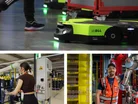
Amazon has introduced the next-generation Proteus at its Delivering the Future event in London today.
An evolution from the original autonomous robot, this new technology delivers greater scope and capability to better support employees in their daily workflows.
It is leading to an environment in which employees can direct Proteus in the same way they would communicate with a colleague – using plain, conversational language, no longer needing technical commands or a programming interface.
Staff members can tell the robot what they would like done and the technology will take care of it.
Streamlining workflows and heavy lifting
Like its predecessor, the new Proteus is engineered to handle the heavy lifting. By taking over physically gruelling tasks, such as hauling massive carts and trekking long distances, it liberates employees to focus on sharper, higher-skilled roles like quality control and inventory management.
While the first-generation Proteus successfully automated dock areas across 25 US facilities by moving carts weighing up to 400 kilogrammes, the next generation breaks out of those boundaries.
The upgraded system can now navigate an entire facility, seamlessly moving containers from arrival docks directly to employee workstations across both fulfilment centres and delivery sites.
Beyond extended mobility, the way humans interact with the machine has fundamentally changed. Thanks to breakthroughs in artificial intelligence, the new Proteus processes natural language, allowing team members to delegate tasks simply by speaking to it just like they would to a human co-worker.
These technological advancements are fuelling Amazon's massive push to modernise its European operations, with a planned investment exceeding €10bn (US$11.4bn) over the next few years.
This initiative also accelerates the rollout of Vulcan, Amazon's pioneering robot featuring advanced tactile feedback. Far from reducing human staff, this modernisation wave coincides with a major regional expansion, as Amazon aims to create 25,000 new jobs across its European fulfilment network.
Scott Dresser, Vice President of Amazon Robotics, says: "You tell it what needs to be done. It figures out the priority, the route, the timing. It becomes your assistant for material movement."
The system is designed to handle the heavy lifting and help support site safety. It is currently being piloted in Amazon's labs, with deployment in Europe planned for the first half of 2027.
The evolution of warehouse dexterity
Amazon’s automation strategy extends well beyond mobile transport. The company is heavily investing in collaborative technology and advanced robotic manipulation, a field focused on giving machines the precision and dexterity needed to handle individual items seamlessly.
A standout example of this next-generation tech is STARK, a collaborative robotic system designed to handle heavy industrial totes.
The concept actually originated from a front-line employee who wanted to improve workplace safety and streamline everyday operations.
Working directly alongside human staff, STARK lifts loaded totes off conveyor lines and transfers them to carts, a task that previously subjected workers to constant, heavy lifting.
Following a successful debut pilot in Barcelona, Spain, Amazon is on track to deploy STARK across 15 European sites by 2027.
Another cornerstone innovation is Vulcan, which introduces a groundbreaking capability to the warehouse floor: a sense of touch. By merging visual tracking with tactile feedback, Vulcan can see and feel items simultaneously, giving it the unique ability to navigate cluttered, densely packed storage spaces with care.
Originally engineered for a facility in Spokane, Washington, Vulcan has since expanded its footprint to master even more complex picking assignments at Amazon's Hamburg location in Germany.
Armin Cossmann, Vice President of operations for Europe, adds: “This transformation is designed to deliver a step-change in how we support our employees and serve our customers.
"Customer expectations aren't slowing down, and neither are we."

Balancing automation with job creation
As part of these investments, Amazon plans to grow its European fulfilment centre workforce by 25,000 in the coming years.
Since introducing robotics into its operations, Amazon has hired hundreds of thousands of employees globally and created new categories of jobs including reliability, maintenance and engineering roles.
"Europe is at the centre of how we’re building our operations for the future," Scott adds.
"The investment we're making here, the talent we're building with here, the technology we're deploying here, this is where the next chapter of operations innovation is being written."