
General Motors: Using Nearshoring to Shield Supply Chains

General Motors (GM) Mexico has announced an investment of US$1bn into its manufacturing operations. The strategic announcement was made by Paco Garza, the President of GM Mexico, who anticipated significant challenges over the course of 2026.
This substantial capital injection aims to strengthen the position of GM in the domestic market in Mexico, where the organisation remains a top vehicle seller. With 198,153 units sold in 2025, the company maintains its second-place position in the industry and achieved a market share of 12.2% for that period.
This investment comes amid a turbulent time for trade relations between Mexico and the US, with continued uncertainty regarding tariffs for cars and automotive parts destined for export.
GM currently operates several manufacturing facilities in Mexico to produce a range of cars and car parts. With its regional headquarters located in Mexico City, the company has operated in the country for almost 90 years and employs more than 25,000 people.
It currently manages four manufacturing complexes in the country and an engineering centre. These facilities include manufacturing sites in Toluca, Silao, San Luis Potosí and Ramos Arizpe.
Additionally, GM Mexico manages a regional engineering centre in the State of Mexico.

Navigating uncertain trade and tariffs
Manufacturing vehicles is significantly cheaper in Mexico compared to the US, which is a key reason why several leading car manufacturers who have sites in Mexico choose to manufacture within the region. However, external pressures are impacting procurement strategies.
In March 2025, President Trump announced a 25% tariff on automobiles and certain automobile parts, including engines and engine parts, transmissions and powertrain parts and electrical components.
Following this, in October 2025, President Trump signed a proclamation to impose tariffs on imports of medium and heavy-duty vehicles and parts and buses which imposes a 25% tariff on imports of medium- and heavy-duty trucks and truck parts.
Some of these tariff measures are yet to be implemented, remain uncertain or require certain conditions met to be exempted.
For manufacturers wishing to export vehicles to the US, the current landscape is less than ideal and presents complex challenges for supply chain leaders.
Sustainability, procurement and supply chain leaders won’t want to miss Sustainability LIVE: The US Summit, taking place at Navy Pier, Chicago, on April 21–22.
Co-located with Procurement & Supply Chain LIVE, the event unites senior decision-makers at a time when supply chains, sustainability and business performance are more interdependent than ever.
Secure your place now for The US Summit – group booking discounts available.
Nearshoring offers supply chain stability
In contrast to its North American operations, GM has 10 joint ventures, two wholly owned foreign enterprises and more than 58,000 employees in China. According to a report from McKinsey, car manufacturers operating in China are faced with a host of new challenges as well as opportunities.
In China, the automotive industry continues to be a major contributor to its economy. However, the Chinese market has multiple issues including an oversupplied market which is leading to price wars.
In addition to these market dynamics, the relationship China holds with the US on tariff measures is one that also sees intensive friction between the two superpowers.
US manufacturers looking to nearshore may look to Mexico as a solution as despite ongoing uncertainty over tariff implementation, manufacturers with proximity to the US market may see it as a more stable bet than China.
According to McKinsey, by optimising their global footprints for maximum utilisation of plants, cost-effective locations and proximity to key markets, car manufacturers can account for costs, fluctuating tariffs and supply chain risks.
Manufacturing strategy for future demand
The investment from GM Mexico will support the domestic market, where the organisation plans to invest the money over the next two years in manufacturing operations as well as future projects.
In 2025, GM Mexico sold 198,153 units and achieved a market share of 12.2%. The company remains a key leader in specific market sectors including large SUVs, where it currently holds 78.8% of market share in the country.
Regarding the strategic direction and the financial results leading up to this investment, Paco says: “We closed 2025 with solid results, reaffirming our commitment to offering our customers innovation, quality and value in every vehicle.
"We anticipate a challenging 2026, where we will adapt our strategy to respond to the evolving needs of our customers.
“As part of this new strategy, and in line with the Mexican government’s efforts to strengthen the domestic market, we will invest one billion dollars over the next two years in our local manufacturing operations and continue working on future projects focused on domestic demand, reinforcing our long-term commitment to Mexico.”
Company portals


Executives
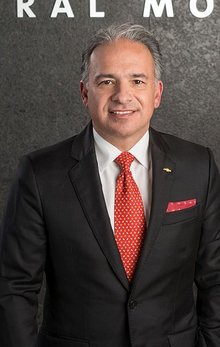
Paco Garza
CEO