How Cargill is Innovating to Decarbonise Shipping
Cargill, known for providing food, ingredients, agricultural solutions and industrial products to nourish the world in a safe, responsible and sustainable way, is advancing a new era in sustainable shipping.
By putting innovation and collaboration at the core of its mission to move goods responsibly across the globe, through wind-assisted propulsion technologies, dual-fuel methanol-powered vessels and digital solutions, Cargill is setting the standard for helping the industry move towards the International Maritime Organization's (IMO) 2050 net-zero target.
Through a mix of technical expertise with a commitment to industry-wide partnerships, Cargill is aiding the maritime industry in future-proofing itself, while also allowing customers to hit their sustainability targets.
"Decarbonising shipping is a monumental task that requires courage, innovation and collaboration," says Jan Dieleman, President of Cargill's Ocean Transportation business.
"Our role extends beyond freight-shipping services; we aim to catalyze a shift across the industry toward sustainable practices. Through strategic investments in cutting-edge technology and robust partnerships, we are accelerating the journey to net-zero emissions in shipping."
Innovating with wind-assisted propulsion
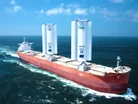
At the forefront of wind-assisted propulsion is the Pyxis Ocean — the first dry bulk vessel equipped with BAR Technologies' WindWings — which completed its maiden voyage back in 2023. The WindWings are large, rigid sails which harness wind power to reduce fuel use and emissions.
Along with WindWings, Cargill has expanded its wind-assisted technology programme to include VentoFoil vertical suction sails on the NBA Magritte and rotor sails on the TR Lady.
These three vessels showcase experimentation and learning before scaling up technical, operational and commercial aspects. These technologies further utilise wind power to decrease fuel dependency and emissions, aligning with the IMO's targets to have 5-10% of maritime energy from renewable sources by 2030.

There is a belief at Cargill that wind could make an important contribution to reaching decarbonisation goals in all of the short, medium and long term.
Jan says that while the cost of fuels that could contribute to a zero-carbon future may remain high, developing, testing and improving wind-assisted propulsion technologies before these fuels are available could reduce reliance on them.
How biofuels and methanol-powered vessels are transforming fuels
It is not just wind propulsion; alongside it, Cargill is reshaping fuel usage across its fleet. The company is pioneering biofuels made from renewable sources, such as fatty acid methyl esters (FAME), which provide a drop-in fuel option to lower emissions without extensive engine modifications.
In 2023, Cargill shifted from trialling these fuels to frequent execution as it prepares to scale up. Nearly 172,000 metric tonnes of biofuel blends containing 63,000 metric tonnes of FAME were lifted in 2023.
Cargill represents the first dry-bulk charterer to sign a commercial agreement for dual-fuel methanol-powered ships, expected to be operational within the next two years. Methanol, which is a low-carbon, alternative fuel, offers a scalable pathway to zero emissions.
With the methanol-powered vessels — the first of their kind in commercial service — Cargill showcases how it is proactive when it comes to adopting sustainable fuel solutions to support both its own and its customers' efforts to implement Scope 3 emissions reductions.
How digital solutions push efficiency and sustainability
Cargill also puts digital innovation at the centre of its decarbonisation efforts. Cargill is using advanced digital tools, which include voyage optimisation technologies, to create digital twins of its vessels, thus giving optimal speed and route planning to reduce fuel consumption and emissions.
Partnering with ZeroNorth, Cargill leverages these digital solutions to enhance operational efficiency and sustainability, reinforcing its commitment to data-driven progress toward net-zero.
Partnering for a sustainable future
In its efforts to decarbonise the maritime industry, Cargill knows it needs partnerships to drive sustainable progress.
As a founding member of the Maersk Mc-Kinney Moller Center for Zero Carbon Shipping, Cargill works with industry leaders to test and promote alternative fuels, including ammonia and methanol.
Cargill is also a key player in the Sea Cargo Charter, a coalition dedicated to reducing shipping's climate impact through transparency and shared decarbonisation frameworks.
"As we continue this journey, we're focused on solutions that don't just improve our own operations but drive change across the industry," adds Jan.
"Our vision is a shipping sector that delivers the goods the world needs while protecting our planet's future. We're proud to be part of this transformation and are committed to building a more sustainable future for global shipping."
Explore the latest edition of Procurement Magazine and be part of the conversation at our global conference series, Procurement & Supply Chain LIVE.
Discover all our upcoming events and secure your tickets today.
Procurement Magazine is a BizClik brand