WEF: What Davos 2026 Means for Global Supply Chains
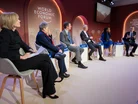
The World Economic Forum (WEF) has convened its annual meeting in the Swiss resort of Davos each January since 1971, bringing together global leaders from government, business and civil society.
The 2025 meeting, themed “Collaboration for the Intelligent Age”, sparked conversations around AI, digitalisation and the energy transition. Its programme focused on five key areas: rebuilding trust, reimagining growth, investing in people, safeguarding the planet and industries in the intelligent age.
Reflecting on the event, Angela Hultberg, Global Sustainability Director at Kearney, said: “I am more positive now than I was a week ago. I fully expected sustainability topics to be set aside, but this was not the case.”
Jim Andrew, Chief Sustainability Officer at PepsiCo, added: “The themes of the week have been action and collaboration – how to move faster and move together to make progress. I’m optimistic and excited for what’s ahead.”
Building resilience in global supply chains
The complexity of modern supply chains was a recurring subject in 2025. For procurement and logistics leaders, building resilience is a critical priority.
Vincent Clerc, CEO of A.P. Moller – Maersk, said: “Attending Davos highlighted just how critical it is to build resilience in global supply chains. Solving challenges at scale demands meaningful action, collaboration and solutions that deliver real impact.”
“What unites us is the shared commitment to progress that benefits industries, nations and communities alike."
Other discussions provided wider economic context, with Anna Bjerde, Managing Director of Operations at the World Bank, telling one session: "If you had women participating as actively as men in the economy, the GDP of the world would be 20% higher."
- Around 3,000 leaders attended Davos 2025, including more than 50 heads of state
Green growth and geopolitical headwinds
The intersection of sustainability and economics remains a focal point.
Sebastian Buckup, Managing Director and Nature and Climate Lead at the WEF, explains: “Green markets have quadrupled in size over the last few years. It's clearly a growth opportunity for many companies. And it's also a reality – there's much more climate-related regulation that companies need to cope with and companies, especially those that have large supply chains, need to build resilience to extreme weather events.”
However, navigating this transition is not without its challenges.
Sebastian points to political instability and geopolitical tensions as major hurdles, adding: “Long-term investment needs stable expectations.”
With global politics in flux, financing skills shortages and regulatory hurdles add further layers of complexity, that impact strategic sourcing and investment.
“Companies are dealing with lots of challenges in the execution of their green strategy,” Sebastian says.

Economic disruption on the 2026 agenda
Looking ahead to the 56th annual meeting in January 2026, interim events are shaping the agenda.
The official theme, “A Spirit of Dialogue”, will likely call on leaders to collaborate across industries, geographies and generations. Preceding discussions have already set a cautious tone.
The WEF’s Chief Economists’ Outlook, released in September 2025, highlights major concerns. According to the report, 72% of surveyed chief economists expect the global economy to weaken in the coming year.
The disruption is seen as structural, with a majority anticipating long-term impacts on natural resources, energy, technology and global value chains. The report also warns that 56% expect greater divergence between the growth pathways of advanced and developing economies.
“The contours of a new economic environment are already taking shape, defined by disruption across trade, technology, resources and institutions,” says Saadia Zahidi, Managing Director of the WEF.
“Leaders must adapt with urgency and collaboration to turn today’s turbulence into tomorrow’s resilience.”
These themes were echoed at the WEF’s Global Future Councils meetings in Dubai, which addressed geostrategic changes innovation and climate action.
Børge Brende, President and CEO at the WEF, says of the Dubai events: "In this new, more uncertain era, dialogue is our greatest source of innovation and resilience.
"Only through open exchange – across disciplines and industries, with a range of perspectives – can we unlock the ideas and trust that we need to move the world forward together.”