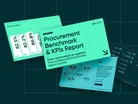

Something is shifting in mid-market procurement and the data makes it hard to ignore. Average spend under management has grown 32% in two years, rising from $6.3M to $8.3M. Nearly 77% of transactions now flow through POs, up from 71.8% in 2023. More than 61% of orders are being placed through guided buying channels.
And in some industries, AP cycle times have been cut by more than half. These aren't projections or aspirational benchmarks; they're drawn from Procurify’s 2026 Procurement Benchmark and KPIs Report, analysing US$30bn+ in anonymised spend data across 700-plus real organisations, spanning seven industries, between 2023 and 2025.
What the numbers reveal isn't just that procurement is getting more efficient. It's that the foundational work (think structured intake, policy-enforced approvals, auditable spend data) is already being done.
And organisations that have built that foundation are now standing at the threshold of something more significant: procurement that doesn't just process spend, but anticipates, guides and optimises it.
The question isn't whether this shift is happening. It's whether your organisation is part of it – or watching it happen to others. The report gives you the numbers to find out.
Procurement teams are under increasing pressure to move beyond operational efficiency and demonstrate real strategic value. But making that shift isn’t always straightforward.
Domo's Head of Procurement Practice, Chris Sweeney, shares how a structured approach to total spend visibility and opportunity assessment can help procurement teams demonstrate and deliver their full strategic potential within the organisation.
Chris spoke to Procurement Magazine to share practical insights on what it takes to make procurement truly strategic.

Modern finance and procurement departments are currently navigating a treacherous landscape where sophisticated fraud attempts collide with increasingly stringent regulatory mandates.
According to the Trustpair 2026 Fraud Report, the threat landscape has shifted significantly, with 71% of US companies reporting a surge in AI-powered attacks over the last year.
This technological evolution in criminal tactics has left nearly half of all finance leaders identifying AI-generated fraud as a premier operational challenge.
While external threats grow more complex, internal compliance pressures are also intensifying. New Sarbanes-Oxley (SOX) internal control requirements and updated Nacha rules for ACH payment security are forcing organisations to overhaul their existing protocols.
These mandates necessitate the implementation of more robust vendor verification and payment validation controls to ensure every transaction is legitimate and secure.
North Highland, a premier transformation consultancy, has teamed up with ORO Labs, the leader in agentic procurement orchestration, to redefine how global enterprises handle purchasing.
This collaboration ensures that employees get exactly what they need through a seamless and intuitive experience. By naming North Highland an official change partner, ORO Labs is prioritising the human side of digital transformation to bridge the gap between software implementation and actual enterprise-wide utility.
While many procurement teams are racing to invest in AI and automation, they often hit a wall after the initial rollout because the challenge extends far beyond the technology itself.
The partnership addresses this by focusing on driving deep adoption, boosting overall productivity and ensuring high user satisfaction across the board. North Highland brings a pragmatic approach to the table, blending talent with technology to turn ambitious corporate visions into measurable value and long-term impact.

The escalating military action between the US and Israel against Iran has brought shipping traffic in the Strait of Hormuz to a near standstill.
The resulting disruption has sent shockwaves through global procurement networks, affecting supplies of helium required for semiconductor manufacturing, aluminium essential for automotive production and a wide range of raw materials that have seen significant cost increases.
Printed circuit boards are experiencing substantial cost rises as supplies of critical minerals and resins face severe disruption. These components are fundamental to manufacturing almost all electronic devices, from smartphones to computers, making the supply chain crisis particularly acute for procurement professionals across the technology sector.









Executives

Chris Sweeney
Senior Manager & Professional Services Lead Domo
Matthew Klein
Senior Managing Director and Chief Marketing Officer

Sudhir Bhojwani
Co-founder & CEO