
Kaspar Korjus: Why AI Agents Are the Future of Procurement

Kaspar Korjus, Co-Founder and CEO of Pactum, a leading the agentic AI transformation in procurement helps to empower enterprises to use AI agents alongside humans to find negotiation opportunities and close supplier deals at scale.
Pactum began as an early innovator of agentic AI in 2019 and has grown into a global team that’s dedicated to providing actionable and safe solutions for leading brand names, including Walmart and Honeywell.
Before Pactum, Kaspar was the Managing Director of e-Residency, one of Europe’s most ambitious government technology initiatives.
He spoke to Procurement Magazine to discuss how AI agents are changing the economics of decision-making, why suppliers actually prefer "talking" to bots and how to keep autonomous systems within strict enterprise guardrails.
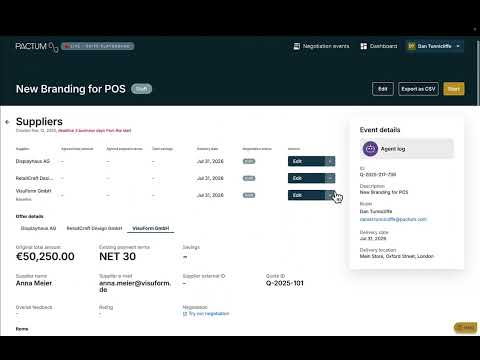
How does your AI find savings in "tail spend" that are usually too small or time-consuming for a human team to even look at?
Tail spend has historically gone unmanaged because the cost outweighed the return. Human-led procurement teams cannot scale across thousands of requisitions, spot buys and post-sourcing decisions, so they prioritise the largest and most strategic areas, leaving the long tail untouched.
Pactum changes the economics of that decision-making. Our AI agents operate autonomously, continuously identifying and executing negotiation opportunities across that long tail without requiring incremental human effort. By operating 24/7, value is increased by freeing up bandwidth for procurement teams to prioritise high-level tasks.
Pactum’s AI agents systematically evaluate single-supplier purchases and fragmented spend, identifying opportunities that would otherwise go uncaptured. Applied across hundreds or thousands of transactions, this unlocks measurable savings in categories traditionally considered non-negotiable.
Our AI agents are purpose-built for specific procurement workflows, enabling enterprise-grade execution across requisitions, tail spend and post-sourcing activity. This allows organisations to extend procurement coverage beyond strategic suppliers and capture value across the full supplier base.
The result is measurable, compounding impact. Enterprises move from episodic intervention to always-on execution, unlocking savings in areas previously considered too small, too fragmented or too time-consuming to manage.
Why do suppliers actually prefer negotiating with a bot over a person, and does it help or hurt the long-term relationship?
Suppliers often prefer negotiating with AI agents because the process is more consistent, transparent and efficient. Instead of navigating different negotiation styles, timing or pressure from human buyers, they engage in a structured, data-driven process with clear parameters and immediate responses. That predictability reduces friction and makes it easier to reach outcomes faster.
Pactum’s agents are designed to create mutually beneficial outcomes, not just extract savings. They operate within predefined guardrails and continuously learn from thousands of data points across negotiations, refining how they communicate, structure offers and evaluate trade-offs.
This is reflected in practice. In supplier surveys, between 76% and 82% reported preferring to negotiate through Pactum’s chatbot-style interface. They cited faster agreement times, less friction and, importantly, better terms as key advantages. Some even described the AI as more polite and easier to work with than traditional negotiations, which can often become tense.
And rather than harming relationships, agentic AI strengthens them. Suppliers benefit from a more predictable and professional experience, while procurement teams maintain full control through defined policies and guardrails.
The result is a system that not only scales negotiation but also continuously improves it. Pactum’s agents learn from every interaction, becoming more effective over time and driving stronger outcomes for both buyers and suppliers.
If an AI signs a contract for a Fortune 500 company, who is legally responsible? How do you make sure the bot doesn't "go rogue" and overspend?
An AI agent doesn’t carry legal responsibility on its own. The enterprise remains fully accountable for any agreement, just as it would with a human employee or procurement system. Pactum’s agents act as an extension of the procurement team, executing negotiations within clear policies and thresholds that are defined by the organisation.
What’s different is not the ownership, but the consistency of execution. Pactum is built to operate within strict enterprise guardrails. Before any negotiation begins, companies define acceptable parameters for pricing, terms, suppliers and outcomes. The AI cannot act outside of those constraints, and every action is transparent, trackable and auditable in real time.
In fact, the system introduces more control upstream than traditional processes. Pactum’s platform automatically validates inputs like contract terms, preferred suppliers and pricing before negotiations even begin, ensuring that only compliant, commercially relevant opportunities are executed.
This is why “going rogue” isn’t how the system behaves. The agents are designed to operate with autonomy, but within defined boundaries. They continuously evaluate data, adjust strategies and execute negotiations at scale, but always within the rules set by the business.
The result is a more governed system than manual procurement. Instead of relying on individual judgment across hundreds of decisions, companies apply consistent policies across every negotiation, with full visibility and control, while the AI handles execution.
Does this tool actually talk to our existing systems (like SAP or Coupa), or is it just another "silo" that my team has to manage manually?
Pactum is designed to integrate directly into core business systems, not sit alongside them as another silo. We have strong partnerships with SAP and Coupa to ensure that customers using these platforms can deploy impactful AI agents directly within their existing environments. This seamless workflow integration significantly improves pricing and terms without leaving the system or adding manual steps.
In practice, that means negotiations happen within existing procure-to-pay processes. Pactum evaluates incoming requisitions, aligns data, identifies where negotiation is relevant and executes within those workflows so teams don’t need to switch systems or manage parallel tools.
The goal is to eliminate fragmentation, not create it. By embedding AI agents into existing systems, Pactum connects requisition intake, opportunity identification and negotiation into a single, continuous workflow.
The result is not another tool to manage, but an intelligence layer that activates within current environments, allowing procurement teams to scale execution without adding operational complexity.
Company portals

Executives

Kaspar Korjus
Co-Founder & CEO