Pactum: Why Procurement is the Proving Ground for Agentic AI

While many business functions are stuck in the "AI experimentation" phase, procurement has emerged as the definitive proving ground for agentic AI.
Paige Wei-Cox, Chief Product Officer at Pactum, explores why procurement’s rule-based structure makes it uniquely suited for autonomous negotiation. Paige breaks down the shift from simple workflow automation to AI-native execution, detailing how multi-agent systems drive measurable ROI, maintain rigorous governance and provide a scalable blueprint for the future of the autonomous enterprise.
Procurement seems to be ahead of other business functions in deploying autonomous AI. What structural or cultural factors make procurement such a natural proving ground for agentic AI compared to areas like finance or operations?
Procurement has moved ahead because the work is structured around rules, constraints and measurable outcomes. It sits at the center of enterprise commercial intent, yet remains execution constrained. Most organisations have digitised intake and routing but still rely on humans to convert requests into negotiated outcomes. The structural opportunity is to close that gap.
Unlike more open-ended or centralised functions, procurement workflows are repeatable, externally facing and governed by clear policies, approval thresholds and commercial boundaries. That structure makes it possible to give agents real authority without introducing uncontrolled risk. The function is limited less by creativity than by execution capacity and scale.
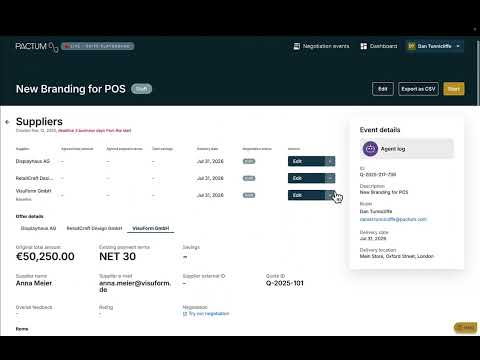
Where procurement is heading is toward an operating model that connects Alignment to Opportunity to Autonomous Execution. Requests are validated for completeness, policy compliance and commercial relevance before negotiation begins. Once aligned, the system determines whether a commercial opportunity exists. If it does, specialised negotiation agents execute within defined guardrails.
This is not workflow automation. It is a purpose built, AI native, team of agents operating continuously behind the scenes.
Embedded directly inside P2P environments such as SAP and Coupa, Pactum meets buyers where they already work. There is no additional interface to learn and no disruption to existing processes. Procurement is ahead because it has structured policies, measurable financial outcomes and repeatable commercial interactions. That makes it the first function ready to move from AI assistance to AI execution. Buyers remain in control while Pactum operates at scale.
Many leaders still struggle to see measurable ROI from AI investments. Based on Pactum’s experience, what are the most tangible performance indicators, like cycle time or supplier responsiveness, that demonstrate real value and scalability in AI-driven procurement?
ROI becomes tangible when AI executes commercial intent rather than simply surfacing insights.
In procurement, that shows up in reduced negotiation cycle time, improved mass supplier outreach and responsiveness, increased compliance, expanded tail and mid-tier spend coverage, improved working capital through optimised payment terms and realised savings captured without additional headcount. Agents reduce bottlenecks created by human bandwidth limits and unlock value in high volume, lower visibility transactions.
The advantage is consistency. Agents apply the same policies and commercial standards across thousands of interactions without fatigue or prioritisation bias. This expands organisational capacity while allowing teams to focus on strategy, supplier relationships and exception handling.
The deeper shift is architectural. Traditional procurement technology optimises isolated steps. Pactum connects commercial decisioning and autonomous execution into a single AI native layer. Requests are qualified and evaluated to determine whether negotiation is worth pursuing and specialised agents execute at scale.
Once commercial intent is defined, negotiations run one-to-many across suppliers, categories and use cases. There is no supplier onboarding required. Campaigns are structured, governed and deployed in under a week. Because Pactum operates inside existing enterprise systems, negotiated outcomes are captured directly into price lists, catalogues and procurement records. Value is not theoretical or dashboard based. It is executed and embedded.
That is when AI moves from experimentation to sustained financial impact.

Governance is a recurring concern for enterprises adopting AI. How do Pactum’s autonomous negotiation agents maintain compliance and transparency without sacrificing autonomy or efficiency?
Governance is foundational to the architecture. Pactum is AI native and multi-agent by design. Each agent is specialised and independently governed, operating within clearly defined mandates, pricing thresholds, approval rules and escalation paths set by the enterprise. Buyers define intent and guardrails. Agents handle scale.
Agents are intentionally narrow in scope. They are not general-purpose systems. They are given clearly defined roles, objectives and measurable success criteria before deployment, which ensures autonomy operates within human defined boundaries from the start.
Only complete, policy compliant and commercially relevant requests move forward. This prevents autonomy from being applied indiscriminately. Downstream agents execute negotiations within defined commercial boundaries. If a situation exceeds an agent’s mandate, it escalates automatically.
Every interaction is traceable and auditable. Enterprises can review decision paths, applied policies, concessions exchanged and final outcomes. Because Pactum is embedded inside systems of record such as SAP and Coupa, execution reinforces governance rather than bypassing it. In many deployments, compliance improves because policies are applied consistently across thousands of transactions.
Autonomy works when trust, control and measurable value are built into the system from the start. Risk does not come from intelligence itself, but from misalignment. Alignment, governance and embedded execution are what make autonomy durable.
You’ve seen multi-year deployments across major global enterprises. What lessons from procurement’s AI journey could serve as a blueprint for other industries aiming to scale AI responsibly while retaining human oversight?
Procurement’s experience demonstrates that AI scales responsibly when it is tied directly to commercial outcomes and embedded inside existing operating environments.
The key lesson is that optimising isolated steps is not enough. Real transformation happens when alignment, opportunity identification and execution operate as a connected, closed loop.
Start with structured workflows where authority and risk are clear. Embed governance at the architectural level. Separate strategy from execution so humans define intent and guardrails while agents execute consistently at scale. Ensure negotiated outcomes are durable by embedding them into governed systems, rather than treating negotiation as a one-time event.
Human oversight does not disappear as autonomy increases. It evolves. People shift away from manual execution toward supervision, calibration and exception handling, while decisions outside defined limits escalate back to humans to preserve accountability.
Procurement is becoming the first enterprise function to demonstrate that a multi-agent, AI native system can qualify requests, identify where negotiation is worth doing, execute operations at scale and embed results into durable structures.
That is the category being built. It represents the shift from process optimisation to continuous commercial execution and signals where enterprise AI is heading next.
Company portals

Executives
Paige Wei-Cox
Chief Product Officer