How L'Oréal Refills Drive Sustainable Packaging Procurement

The beauty and fashion industries rely heavily on affordable, durable plastics, yet this dependency contributes to a staggering environmental challenge: more than 280 million tonnes of short-lived plastic products enter waste streams annually, as reported by the UN Environment Programme.
Recognising this critical issue, L'Oréal launched its inaugural cross-divisional campaign in 2025, championing the refill movement to reconcile luxury product expectations with sustainable packaging solutions.
At the forefront of this initiative is Jacques Playe, L'Oréal's Global Head of Packaging and Product Development. Leading an international team of packaging and development specialists, Jacques focuses on creating innovative, high-performance products that simultaneously minimise environmental impact.
This requires supplier innovation partnerships, coordinating cross-industry collaboration, standardisation and joint R&D investments with packaging and component suppliers.
Here, Jacques shares his insights on why refillable packaging represents a pivotal solution for the industry's sustainability challenges.
What benefits can refills bring?
Refills allow us to merge sustainability, desirability and performance – delivering the same exceptional formulations consumers love, in innovative packaging designed to significantly reduce resource use and environmental impact.
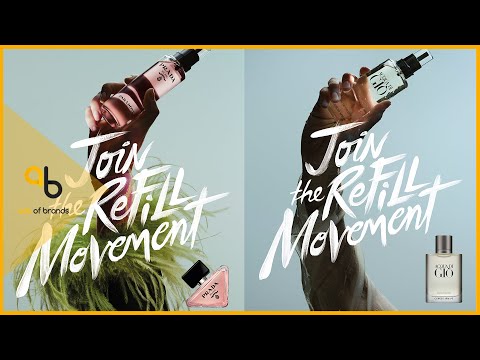
Refills present very tangible benefits, demonstrating how they can be better for the planet and the pocket. For example, each time you buy a 100ml refill instead of rebuying two 50ml bottles of Prada Paradoxe EDP, you make a difference by saving 44% glass, 100% metal, 67% plastic and 61% cardboard.
Beyond fragrances, we are expanding refills across all divisions.
In Europe, Elvive — the world’s #1 shampoo – now offers refillable pouches, reducing plastic use by 60% across several product lines. This initiative has the potential to impact millions of consumers.
What are the challenges in implementing refill systems?
Scaling up refill systems presents a challenge of industrialisation.
From a manufacturing and packaging perspective, developing standardised, universal refill systems across multiple brands and product formats requires significant innovation and adaptation of our production lines.
For instance, we’ve worked closely with glass manufacturers and pump suppliers to create a universal system that can be used across the industry.
We have also adapted our manufacturing sites in France, such as Gauchy and Aulnay-sous-Bois for fragrances, Vichy for skincare and Burgos in Spain for haircare, to accommodate these new formats.
How is L’Oréal Groupe promoting refills and educating consumers?
On the consumer side, our most important task remains awareness and adoption.
While 78% of consumers express interest in buying more sustainable products, many remain unaware of refillable options and their lower environmental impact.

That’s why L’Oréal has launched its first global multi-brand, multi-category, multi-channel campaign #JoinTheRefillMovement, designed to encourage consumers to embrace refills as the latest beauty ritual and contribute to a more sustainable future.
The campaign brings together some of the Groupe’s most iconic brands, including Lancôme, Armani Beauty, Yves Saint Laurent Beauty, Kiehl’s, Mugler, Maison Margiela Fragrances, Prada Beauty, Valentino Beauty, L’Oréal Paris, Kérastase, L’Oréal Professionnel and La Roche-Posay.
Individual brands are also developing branded hero content to amplify the campaign – featuring brand ambassadors such as Emma Watson for Prada Beauty.
How much of a difference are refills making to L’Oréal Groupe's sustainability strategy?
L’Oréal offers a large number of refill solutions across all major product categories (skincare, fragrances, makeup, haircare and hygiene products) and all our divisions.
The material saving using refills is major, for example: Kérastase Elixir Ultime Oil offers a new refillable format made of 10% recycled glass and 95% recycled plastic.
Between 2019 and 2024, the Group has also significantly adapted its manufacturing sites around the world to enable a 17-fold increase in the number of refillable options available.
By scaling up refills, we are not only reducing the environmental footprint of our products but also catalysing industry-wide change, setting new standards for circularity and empowering millions of consumers to participate in the refill revolution.