IFS and Boston Dynamics: Harnessing Agentic AI and Robotics
As procurement leaders face mounting pressure to optimise resources, manage risk and drive strategic value in industries where field operations are critical, a new partnership between IFS, a global provider of industrial AI software, and Boston Dynamics, the pioneer in mobile robotics, is setting a benchmark for how technology can transform these challenges – turning asset management from a reactive to a predictive discipline.
The partnership between IFS and Boston Dynamics offers a groundbreaking collaboration to revolutionise how asset-intensive organisations manage and optimise their field operations.
By bringing together Boston Dynamics' autonomous inspection robots with IFS.ai, they will form a fully-agentic AI system which seamlessly connects sensing, predictive decision-making and action in the field.

Connecting physical and digital worlds
As labour and skills shortages impact industrial customers, causing service gaps and prolonged outages, there exists a real need for technology which can supplement field workers.
Christian Pedersen, Chief Product Officer at IFS, says: "Asset-intensive organisations face unrelenting pressure to improve operational performance. Together with Boston Dynamics, we're delivering a truly autonomous system that connects the physical and digital worlds for the first time.
"IFS.ai and IFS Loops turn robot observations into enterprise action, from preventative maintenance scheduling to predictive failure analysis and automated anomaly detection. Data flows from the field into enterprise systems, decisions are made autonomously and actions are executed back in the field, all within a single integrated platform."
The solution was showcased at Industrial X Unleashed in New York earlier this month. The duo demonstrated the combination of physical and agentic AI to form this end-to-end automation system to connect robots and enterprise data in high-potential applications.
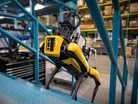
Boston Dynamics' Spot robots patrol industrial facilities, gathering vital operational intelligence as they move.
Equipped with thermal imaging, Spot identifies temperature irregularities, detects acoustic signatures of air or gas leaks, interprets analogue gauge readings for pressure and flow metrics, monitors status indicators, spots safety hazards such as chemical spills and measures electrical anomalies.
This stream of sensor data flows directly into IFS.ai, where autonomous AI agents analyse findings, make informed decisions and initiate corrective actions – establishing a continuous feedback loop from data collection to automated response.
The partnership is particularly important for those industries where field operations are vital, including manufacturing, energy, utilities, mining and other asset-intensive sectors. With field workers comprising part of the 70% of the world's workforce that do not work behind a desk, IFS and Boston Dynamics are unlocking value in areas that have remained underserved by generic AI applications.
Dr. Merry Frayne, Director of Product, Boston Dynamics, adds: "This collaboration represents the future of industrial operations. Our robots excel at navigating complex environments and gathering critical data.
"Combined with IFS' agentic decision-making capabilities, we're enabling organisations to achieve levels of operational excellence and safety that simply weren't possible before."
Measurable improvements across critical operations
Together, IFS and Boston Dynamics are targeting measurable improvements across three critical operational metrics:
Safety: Autonomous inspections reduce human exposure to hazardous environments whilst increasing inspection frequency and thoroughness
Efficiency: Intelligent automation enables faster decision-making and response times, optimising resource allocation
Uptime: Predictive insights and automated actions help prevent failures before they occur, maximising asset availability
Ron Utterbeck, CIO at Eversource, an IFS customer, says: "As the largest New England energy provider managing critical infrastructure across multiple states, this integration has the potential to radically transform our operations.
"As our grid continues to advance we need to utilise not only traditional data gathering but more advanced data gathering and modelling.
To meet the reliability and the energy demands for our customers, we look forward to the opportunity in utilising advanced industry technology such to enable data collection at a different level that can support routine inspections of substations and facilities with automatically prioritising and dispatching our crews.
"This will allow our highly-skilled crews to be focused on the right priorities at the right time and ensure mission-critical work is completed. It's a genuine shift from reactive to predictive maintenance."
Company portals


Executives
Christian Pedersen
Chief Product Officer
Merry Frayne
Director of Product

Ron Utterbeck
Vice Chair Board of Directors