
FIFA: Procurement’s Role in Building a Unified World Cup

The FIFA Men’s World Cup has always been at the top of the table when it comes to global logistics, but the 2026 edition represents a giant leap in complexity. For the first time, the biggest event in football will be hosted across North America, spanning 16 cities in three sovereign nations: Canada, Mexico and the United States. This isn’t just a collection of masterclass performances from some of the sport’s biggest stars; another leading performance will take place largely out of sight, its cross-border procurement.
With an event of this scale requiring the synchronisation of three different regulatory systems, currencies and transport networks, the tournament must support an expanded roster of 48 teams and 104 matches.
Navigating the North American challenge
The scale of this triple-nation procurement model has forced FIFA to move away from traditional host-city silos. Instead, the organisation is implementing a centralised supply chain strategy that treats North America as a single, unified territory. This involves navigating the intricate USMCA trade landscape to ensure that millions of pounds of broadcast equipment and team kits move across borders without the friction of traditional customs delays.
Central to this is the establishment of pre-vetted procurement routes designed for speed. By coordinating with national border agencies years in advance, procurement teams have secured the movement of critical goods, ensuring that the 104-match schedule remains disruption-proof regardless of geographical distance.

Modular thinking, temporary delivery
A major part of the 2026 operation will rely on temporary and modular infrastructure rather than permanent construction. That means procuring items such as seating, hospitality structures, media facilities and overlay assets that can be installed, removed and reused after the tournament.
This approach supports wider sustainability goals by reducing unnecessary permanent build-out and encouraging rental, reuse and circular sourcing models. It also places greater emphasis on supplier due diligence, with vendors expected to meet standards covering human rights, environmental performance and responsible sourcing.
Digital coordination and local legacy
The digital side of tournament delivery will be just as important. Managing an event of this scale requires real-time visibility across operations, logistics and supplier performance, with technology helping to identify bottlenecks before they affect delivery.
At the same time, the tournament creates a major opportunity for local businesses. Host city supplier programmes and local sourcing initiatives can help small and medium-sized enterprises participate in hospitality, logistics, retail and event services, leaving a broader legacy beyond the final whistle.
Projections from economic impact studies suggest the tournament could contribute billions to the continental GDP, with the United States alone potentially seeing a significant multi-billion dollar boost.
From the pitches themselves—many of which are being converted from artificial turf to temporary natural grass specifically for this tournament—to the cables beneath the stands, the 2026 World Cup is shaping up to be a blueprint for how mega-events can combine scale, efficiency and more responsible procurement.
Rock-it Cargo: Centralised supply chain
To manage the unprecedented logistical complexity of a 104-match tournament, FIFA appointed Rock-it Cargo as the Official Logistics Provider. The task involves moving thousands of tonnes of broadcast equipment, VAR systems and team kits across 16 cities.
By leveraging the USMCA framework, Rock-it Cargo provides a centralised supply chain, ensuring friction-free movement from international freight forwarding to last-mile delivery.
FIFA Secretary General Mattias Grafström says: "In Rock-it Cargo we have found the perfect partner to entrust with the critical logistics services for the biggest FIFA World Cup ever. We've been impressed by Rock-it Cargo's experience and attention to detail, teamwork and passion to deliver operational excellence. Their global model fits perfectly with our extensive ambitions for the tournament."
The model prioritises operational excellence across the continental footprint. Daniel Rosenthal, President and CEO of parent company GCL, adds: "For nearly 50 years our team has been trusted by the world's biggest artists and North American sports leagues to deliver extraordinary experiences through extensive planning, contingency management and outstanding event coordination."
This partnership ensures a sustainable, disruption-proof operation capable of scaling to the ambitions of the largest World Cup in history.

How the beautiful game is watched, engaged with and enjoyed
As the Official Technology Partner, Lenovo is providing the hardware and AI-driven solutions required to manage the scale of 104 matches across North America. Central to this digital procurement is an Intelligent Command Centre that uses real-time analytics and digital twins of venues to optimise tournament operations and fan flow.
The innovation extends to the pitch through 3D Digital Avatars, which support Semi-Automated Offside Technology by reflecting the exact physical dimensions of players. Arthur Hu, Lenovo CIO, said: “We are working with FIFA to create the next generation of AI enabled 3D avatars, so that the world’s greatest players are represented as realistically and accurately as possible. No two footballers are the same, with the same physique or dimensions. Therefore, each player’s exact dimensions will be taken into account.”
Fans will also experience Referee View cameras featuring AI-driven stabilisation. Gina Qiao, Lenovo CMO, explains: “Being able to provide billions of fans watching FIFA World Cup 2026 a unique and dramatic viewpoint from the very centre of the field is why we got into this Partnership: to change fan experiences for the better, to impact how the beautiful game is watched, engaged with and enjoyed.”
Fanatics: Serving Millions of Fans in Real Time
Fanatics has been selected as the official on-site retail licensee for 2026, managing one of the largest and most complex retail operations in sports history. The remit covers 104 matches across 16 cities, including bespoke experiences at official FIFA Fan Festival locations.
Central to this procurement strategy is the use of on-demand manufacturing and local market operations in Canada, Mexico and the US.
Andrew Low Ah Kee, CEO of Fanatics Commerce, says: “We’re bringing together our expertise across event and physical retail operations, buying and merchandising, product creation, and rapid production to serve millions of fans in real time. This is exactly the kind of challenge our team loves, supporting the world's fans through the joy of sport.”
FIFA Chief Business Officer, Romy Gai added: “This is an incredibly complex undertaking, with 16 host cities across three countries, but Fanatics sets itself apart through an innovative merchandising approach and proven track record delivering standout results at the world’s biggest events.”
By using a local supply chain, Fanatics can produce "quick-strike" products that celebrate unpredictable match moments, ensuring the retail ecosystem remains as dynamic as the tournament itself.
Company portals




Executives

Andrew Low Ah Kee
Chief Executive Officer

Daniel Rosenthal
CEO

Gina Qiao
Chief Marketing Officer and Chief Strategy Officer
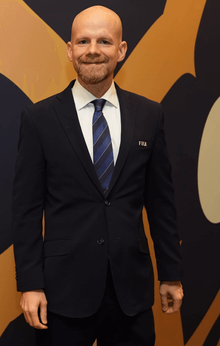
Mattias Grafström
Secretary General
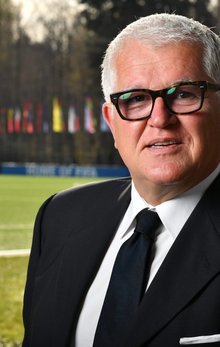
Romy Gai
Chief Business Officer