
Smart Charging Key to Sustainable Procurement Expansion
Electrifying logistics is crucial for reducing carbon emissions, improving air quality and lowering long-term operational costs.
As supply chains transition to electric vehicles (EVs), addressing charging infrastructure limitations is key to a sustainable and efficient logistics network.
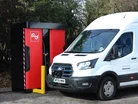
TUAL has completed a month-long trial of its PowerUp Charger with Wincanton, demonstrating how deployable, battery-buffered charging technology can overcome grid constraints and support the shift to EV fleets.
Enhancing EV charging for fleet electrification
Wincanton’s trial of TUAL’s PowerUp Charger focused on improving charging capabilities at one of its e-fleet operating sites in West London.
The trial demonstrated that the charger could enhance on-site charging capacity by up to 250%, enabling 4.9 high-power direct current (DC) charges daily – compared to the previous 1.2 alternating current (AC) charges.
Philip Clarke, CEO and Founder of TUAL, highlights the significance of this innovation: “Myself and the whole TUAL team are delighted to see Wincanton and its clients benefit from our battery-buffered DC PowerUp Charger technology – successfully delivering the dependable, cost-effective and rapidly deployable fast charging that lies at the core of our mission.
“That undertaking is a critically important one in the shift to sustainable fleet operations; businesses across the UK needing to electrify are faced with sites that don’t have the grid capacity to make an efficient transition possible.
“We’re excited to continue our work in helping fleets to electrify faster and would like to thank Wincanton for their commitment and passion for innovation in realising that mission.”
The PowerUp Charger, a mobile and fast-deployable charging solution, was installed in just 15 minutes, providing high-speed DC charging without requiring significant grid upgrades.
The trial supported 19 medium- and large-sized electric vans, reinforcing the charger’s role in optimising logistics operations through smart, sustainable energy solutions.
Overcoming charging barriers in logistics
Charging infrastructure remains one of the biggest challenges for supply chain electrification and operations.
Many organisations face grid constraints when attempting to transition to EV fleets.
TUAL’s analysis found that 50%-80% of sites looking to electrify lack sufficient grid connections, creating a barrier to sustainable fleet operations. Upgrading the grid can take up to three years and cost between £150,000 and £3m, making rapid EV adoption a challenge.
- Available on-site capacity rose by up to 250%
- 4.9 high-power DC charges a day
- Takes 15 minutes to unload, install and deliver off-grid DC charging
- 3,138 clean-air miles during its four weeks in operation
- Saved 1,560kg of CO2 during the four weeks
Claire Charlton, Head of Innovation at Wincanton, underlines the importance of solutions like the PowerUp Charger in addressing these barriers: “On behalf of the whole Wincanton team, I’d like to extend our thanks to TUAL for their cutting-edge technology and their professionalism throughout this pilot.
“Solutions such as TUAL’s are central to making our net-zero ambitions happen and smart innovation is essential for helping businesses expedite the expansion of their fleet electrification, cost-effectively.
“I would also like to extend my thanks to DfT and Connected Places Catapult for delivering the hugely successful Freight Innovation Fund programme.”
TUAL’s PowerUp Charger provides up to 120kW of high-power DC charging, delivering stored energy on demand.
This eliminates dependency on extensive grid upgrades and allows logistics providers to scale EV fleets more efficiently. By reducing charging downtime and improving energy efficiency, the charger supports the logistics sector’s transition to more sustainable operations.
The role of innovation in sustainable logistics
As logistics providers and procurement organisations work towards net-zero emissions, investment in new technologies will be essential.
Hydrogen and biofuels are expected to play a role in long-haul freight, while smart charging solutions will facilitate EV adoption for urban and regional logistics.
Innovations like TUAL’s PowerUp Charger enable supply chain and procurement businesses to embrace EVs without prohibitive infrastructure costs.
Policy support and collaboration between private and public sectors will also be vital in overcoming regulatory and financial barriers. The integration of battery-buffered charging solutions with renewable energy can further optimise fleet operations, making electrification a more viable and cost-effective option.
Wincanton’s successful trial of the PowerUp Charger demonstrates how logistics companies can navigate infrastructure challenges and accelerate the transition to low-carbon operations. By implementing scalable charging solutions, businesses can future-proof their fleets and contribute to a cleaner, more efficient supply chain.
TUAL and Wincanton are addressing procurement's environmental aspects and ensuring that their supply chain operations align with broader sustainability goals by integrating sustainable practices into logistics.
Explore the latest edition of Procurement Magazine and be part of the conversation at our global conference series, Procurement & Supply Chain LIVE.
Discover all our upcoming events and secure your tickets today.
Procurement Magazine is a BizClik brand.