
US, Canada and Europe: Rising Tariff Tensions Across Globe
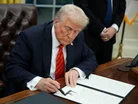
Tension are rising across the world, as a trade war takes shape across the globe as the 25% tariffs on all steel and aluminium entering the US takes effect.
It comes following a day of feared escalation, after President Donald Trump threatened to double the tariff on Canada to 50% on March 11.
The potential increase followed Canada announcing its own increase to electricity provided from Canada to the US.
President Trump announced the original tariff, prompting Ontario Premier, Doug Ford, to confirm that a 25% surcharge on US-bound electricity would be placed. With businesses and homes, estimated to be around 1.5 million, along the northern border states of New York, Minnesota and Michigan set to be affected.
However, following a meeting between the Premier of Ontario and US Secretary of Commerce, Howard Lutnick, who published a statement on social media platform X, saying: "President Trump’s Truth this morning made clear our position on Ontario’s energy tax. I’m glad they listened.
Here is our official statement. Today, United States Secretary of Commerce @howardlutnick and Premier of Ontario Doug Ford had a productive conversation about the economic relationship between the United States and Canada.
Secretary Lutnick agreed to officially meet with Premier Ford in Washington on Thursday, March 13 alongside the United States Trade Representative to discuss a renewed USMCA ahead of the April 2 reciprocal tariff deadline. In response, Ontario agreed to suspend its 25% surcharge on exports of electricity to Michigan, New York and Minnesota."

Counter-tariffs placed by EU
As President Trump's tariff take effect, the EU have announced that it will introduce counter tariffs in retaliation, putting further strain on an already rocky relationship between the world's largest trading bloc and its transatlantic neighbours.
The EU has confirmed that counter-tariffs on €26bn (Approx US$28.3bn) will be implemented on American goods as a result of the steel and aluminium imports tariffs, starting on April 1.
Ursula von der Leyen, the president of the European Commission, said in a statement: "[We] deeply regrets this measure. Tariffs are taxes. They are bad for business and even worse for consumers. These tariffs are disrupting supply chains. They bring uncertainty for the economy.
"The European Union must act to protect consumers and business. The counter-measures we take today are strong but proportionate."
The UK's response
While the EU have implemented its own measures, the UK has said it will not introduce its own tariffs onto the US.
Instead, Britain has said it will look to continue speaking with the US as it looks to obtain a form of exemption.
Reported by PA on March 10, the Prime Minister, Sir Keir Starmer, official spokesman said: “The UK and US have got a strong economic relationship. It’s based on fair and balanced, reciprocal trade and we’re engaging closely with the US administration to make the case for the UK to be exempt from proposed tariffs.
“And, more broadly, we’ve been very clear that when it comes to UK steel industry we remain prepared to defend the UK’s national interest where it’s right to do so.
“But we will continue to take a cool-headed approach to any speculation around tariffs.
“We’ve got a £2.5bn (Approx US$3,23bn) commitment to invest to rebuild the UK steel industry and support communities now and for generations to come.”
How March 11 played out
On March 11, President Trump planned to increase the tariff coming into effect from March 12 – announcing it on the social media platform, Truth Social.
The post states: "Based on Ontario, Canada, placing a 25% Tariff on Electricity coming into the United States, I have instructed my Secretary of Commerce to add an additional 25% Tariff, to 50%, on all STEEL and ALUMINUM COMING INTO THE UNITED STATES FROM CANADA, ONE OF THE HIGHEST TARIFFING NATIONS ANYWHERE IN THE WORLD.
"I will shortly be declaring a National Emergency on Electricity within the threatened area. This will allow the US to quickly do what has to be done to alleviate this abusive threat from Canada."
The post goes on to say that, if long-time tariffs are not dropped by Canada, then President Trump will "substantially increase, on April 2nd, the tariffs on cars coming into the US which will, essentially, permanently shut down the automobile manufacturing business in Canada."
The President once again spoke about making Canada the 51st state, a move which would "make all tariffs and everything else, totally disappear."
Would Canada turn the lights out?
Speaking to CNBC's "Money Movers," not long after President Trump announced the tariff increase Doug said that he would not "hesitate" to shut off electricity exports to the US if Trump continues: "That's the last thing I want to do. I want to send more electricity down to the US, to our closest allies or our best neighbours in the world. I want to send more electricity.
"Is it a tool in our tool kit? 100% and as he continues to hurt Canadian families, Ontario families, I won't hesitate to do that. That's the last thing I want to do."
Canada is the top supplier to the US for steel, as well as being the largest supplier of aluminium. As companies across the US have already voiced their concerns that an increase in prices could quickly follow these tariffs.
Explore the latest edition of Procurement Magazine and be part of the conversation at our global conference series, Procurement & Supply Chain LIVE.
Discover all our upcoming events and secure your tickets today.
Procurement Magazine is a BizClik brand