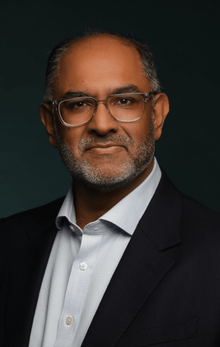
Omer Abdullah on Rethinking Procurement in an AI World

Omer Abdullah, Founder of Proquria explores the existential shifts facing procurement in the age of generative AI.
Drawing on 35 years of industry experience, Omer explains how automation is rapidly climbing the corporate "pyramid of work," moving beyond transactional tasks to absorb cognitive decision-support.
He argues that the future of procurement relies not on technical upskilling, but on elevating uniquely human capabilities like judgment, relationship management and strategic storytelling to prove the function's indispensable value to the C-suite.

As someone who's been in the sector for so long, when people say the function has seen a rapid transformation, what do they mean?
Procurement has been evolving for that entire timeframe. If you go back to the 70s and 80s, procurement was fundamentally more of a transactional, clerical function that was called in after the fact. I think what we realised, certainly in the late 80s and 90s, was that there was a lot of value procurement could bring to the table.
That value translates directly to the bottom line. Over the years it grew in capability, size and sophistication. You had better people going into procurement, more tools and a SaaS boom starting with the dot-com era.
Then suddenly along comes AI, and Gen AI in particular. Now I think we're moving in a very rapid direction of change and evolution. Over the next three to five, even ten years, we'll see some pretty radical change in the function, and for procurement to stay relevant it needs to rethink itself. It needs to rethink its operating model, its people and the skill sets they bring to the table.
Right now we have the luxury of what I'd call corporate inertia, compliance issues, cyber concerns, data security, general risk aversion. That's giving us a little breathing room, but not a lot.
Procurement is radically transforming. I think it's pushing CPOs to really think differently about their organisations and whether they'll be relevant at all. Because if they're not, the CFO is going to say, ‘Well, I can just automate the entire function and get 60 to 70% of the value at a fraction of the cost.
Why don't I just do that now?’ I think the CFO loses a lot by doing that. I think the human element is essential, but it's up to us as a function to prove that.
For procurement to stay relevant it needs to rethink itself.
You talk a lot about future-proofing for practitioners. Why is that something they need to be doing?
It's a survival issue, an existential issue. CFOs are demanding more for less. Internal customers are demanding more of procurement too: you want a seat at the table? Prove it. Technology is pushing the function to do more, and people can DIY a lot of things themselves.
‘Why do I need procurement if I can do this myself?’ I think it's incumbent on the practitioner, if they want to be relevant, to rethink their role, their organisation, and how and what value they deliver.
It's not going to be about the transactional work anymore, and it's not even going to be about a lot of the cognitive and decision-support work. Traditionally, procurement could come in and say, ‘You're talking to this supplier, well here are another six you should be considering’.
How do you get that? You build a market analysis, identify and pre-qualify suppliers. Well, people can do that themselves now.
So what does the practitioner bring to the table? What we're really working towards is how the practitioner upskills themselves so that they're a genuine value-add, so that I can sit down with my marketing customer and say, ‘I understand the issue you're trying to get at, and here's what's happening in the supply market that's really interesting and unique.’
When you bring better insights like that, people start to think, ‘Every time I bring so-and-so into my conversation, I learn something, and they push me to think differently’. So it's an existential issue.
“Internal customers are demanding more of procurement too: you want a seat at the table? Prove it. ”
How has AI reshaped category management?
Category management, from a broad perspective, understanding spend, understanding the supply market, developing and ideating strategies, implementing those strategies, then ongoing category management, every single aspect I've just talked about, there's a provider out there able to service that requirement.
The reality is category management has been upended. It's still important, but it's been upended. Our ability to get insights and intelligence, we now have a wealth of tools, information and insights available to us.
Five years ago we didn't. Category management has transformed. Now we're seeing radical change across the whole source-to-contract arena too, which is exciting, and it's freeing for the practitioner as well.
“Now we're seeing radical change across the whole source-to-contract arena too, which is exciting, and it's freeing for the practitioner as well. ”
What's one thing that procurement is still getting wrong about AI?
I'd say the most foundational thing is that you cannot bolt AI onto what you've already got.
You've got processes that you thought through in a pre-AI world, a SaaS-driven, deterministic environment. A lot of people are saying, 'This is my process, I can just bolt AI onto it.'
I think that's the wrong way to look at it.
The better question is to take a step back and ask, in an ideal, white-space world, what would AI do? And then, how do I ensure the human stays relevant and drives value towards outcomes? So: don't bolt on, rethink, fundamentally rethink your operating model.
“You cannot bolt AI onto what you've already got. ”
Over the next 12 months, what one function which a CPO uses every day will be most transformed by AI?
Anything involving intelligence and analytics that's just transformed, no matter where it sits in the process, whether it's in spend, category strategy development, or executing RFXs.
Anything that requires information you can then organise, transform and pull meaning out of is going to get transformed. So it's exciting times for procurement.
Company portals

Executives
Omer Abdullah
Founder