Improving Financial Strategy and Reducing Risk at PSC LIVE
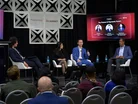
The role of procurement is a vital one, overseeing the financial strategy of organisations and leading efficiency from behind the scenes.
In recent years, geopolitical volatility has brought the procurement function further into the limelight, acknowledging that it is a core driver of operational stability.
At Procurement and Supply Chain LIVE: The US Summit, leaders came together to discuss how to align cost savings and procurement processes with business goals of efficiency and resilience.
The Finance & Payments Forum, sponsored by Coupa, took place on Day One of the event, offering expert insights into driving success.

The shifting role of procurement
Amid ongoing turbulence, procurement leaders have become a key part of developing business resilience and operational efficiency. Though procurement is still about cost savings and ensuring beneficial contract management, it is now a more overt driver of stability and business value.
The role is shifting, but procurement leaders have increasingly found themselves in core strategy discussions, exploring how to do more with less spend, or how to utilise the spend in the most successful way. Traditional procurement functions are blending with cost savings and strategic sourcing in order to build resilience for the business.
Rather than operating as a solo function, procurement is being integrated into more and more business decisions, with less fragmentation across the organisation. This comes with an increasing stress on the importance of cross-company collaboration and a move away from traditional procurement methods.
Instead of relying on fragmented manual data systems, procurement teams are increasingly turning to automation and digitalisation in order to streamline data entry and scanning, allowing procurement to run more efficiently, with less risk of manual error. Despite this adaptation though, delays still remain, and procurement is not at its most efficient.
According to Michelle Yip, Senior Director of Product Management at Coupa, "teams are spending over 26 hours a month just to reconcile data. That's over three working days."
The move to digitalise is happening at a rapid pace, but to achieve full efficiency, with optimal finance and spend, there needs to be closer collaboration and greater levels of visibility throughout individual functions and the company as a whole.
Navigating fragmentation
Traditional business operations have relied heavily on siloed functions. In today's volatile market, the leading companies understand that siloes result in delays and more risks. Procurement and finance, despite relying on each other, have not always had a streamlined workflow with one another. They have operated as separate entities, resulting in delays or miscommunications between sectors.
Now, within the fast-paced world businesses are operating in, the demand for closer collaboration is clear. However, decades of siloed operations has made this a difficult process. Emerging technology and the increase of automation is looking to bridge that gap between procurement and finance. Communication is the key, but with mass amounts of data and constantly changing regulations or markets, automation is the core driver of this communication.
"At Coupa, [the communication gap is] the problem we've been trying to solve. We can't have siloed functions," explains Michelle.
"So we build a platform that can provide visibility from request to PO, to invoice, to payments, to cash management. As soon as a PO comes in, you can send that information to the treasury team. [You still] communicate with the treasury team, but just electronically in the system.
"They see the cash forecast on day one, and then as it moves through the process, you get the invoice, you update that forecast. So treasury teams can get visibility into what's coming and they can plan their cash flow better."
The addition of automation
Technology and AI has become a core driver of this more streamlined workflow. AI can adapt to systems in order to help with guidelines and scan for data points or risks.
Applying digital tools into the system means that specific functions can become a core part of the analysis from the beginning to the end. It allows for more oversight, using less time and less resources. As a result, it has become a core factor of ensuring efficiency and accuracy when managing multiple points of data at once.
"I think in an AI world, the benefit is now you're having an ability to manage all of your spend. It's now about setting rules and structures and guidelines around how you manage that spend versus the individual negotiation," says Adam Paul, Senior Director, WW Procurement at Analog Devices.
"When you set those rules and guidelines and you put it into your system, you can now manage every dime of spend.
"I see it as a great expansion of our rules where you're still going to have your biggest, most strategic suppliers that you're going to have humans managing. That's not going to change, but your category managers are going to be able to span the entire span of your spend. You're going to know where every dime's going. You're going to have data that can back up decisions.
"But really the key is setting up that rules engine and that structure that allows you to manage that spend holistically."
By utilising this technology, procurement leaders and finance leaders can understand exactly where the spend is going, when. It provides untapped value and visibility that allows for less risk and more streamlined operations.
This holistic visibility, driven by digitisation and AI, means that teams can communicate better and understand the roles and functions of each other at a deeper level. This encourages greater communication and more accuracy over finances, spend and cost savings.
Reg Butler, Director of Supply Chain Solutions at BMO Capital Markets adds: "Procurement needs to understand how their payment terms, their timing, their structure move into working capital and how that becomes working capital.
"Finance needs to understand the artistry that's in procurement and negotiation to get to those payment terms, what that structure really means on both sides.
"So it's just understanding that we're not at cross purposes and that's old school communication."
The close collaboration ensures that business functions can be de-siloed in order to operate more holistically and ensure businesses are getting the most out of their spend, every step of the way. The integration of data platforms and AI can help with this significantly, resulting in more visibility and more understanding of a shared goal.
Company portals




Executives
Adam Paul, PMP
Senior Director, WW Procurement

Michelle Yip
Senior Director of Product Management, AP Automation
Reg Butler
Director, Global Trade, Supply Chain Finance