
How ReNew Built India's Renewable Supply Chain From Scratch

Vaishali Nigam Sinha co-founded ReNew in 2011 with her husband Sumant Sinha. The company is now the second largest renewable energy provider in India.
Before entering the energy sector, Vaishali spent a decade in finance across Wall Street and London after completing a master's degree in Public Policy at Columbia University. Her time in investment banking and financial services gave her exposure to capital markets and corporate strategy, but little indication of the operational procurement challenges that would define her work at ReNew.
The skills she developed in financial structuring and stakeholder management would prove unexpectedly relevant when building supply chains in an emerging sector. "Finance teaches you to think about risk, about timelines, about what can go wrong," she reflects. "Those frameworks became useful when we were making sourcing decisions with no precedent to follow."
She now chairs ReNew's sustainability function and its charitable foundation and serves as President of the United Nations Global Compact Network India.
The path from financial services to renewable energy infrastructure was not immediate. According to Vaishali, the transition came from a question about purpose rather than a calculated career move.
Her role at ReNew was not planned. "I thought there was no real role for me at ReNew. I hadn't been an engineer, hadn't had any experience in that space," she says. The assumption that renewable energy required only technical expertise overlooked the procurement, stakeholder engagement and operational complexity that would become central to the business.

Building supplier networks without precedent
ReNew began when sustainability was considered an ancillary concern rather than a viable business model. "People in government or in business thought it was a "nice to do". But nobody thought you could actually make money from a sustainability-related business," Vaishali says.
The company initially connected to a financial services advisory platform. Goldman Sachs then funded the business at five times the requested amount. The scale of capital shifted procurement requirements immediately.
"Suddenly there was a huge amount to be done and we were a small team, so I got sucked into ReNew accidentally, not intentionally," she says. The absence of an established supply chain meant every vendor relationship had to be built from the ground up.
The renewable energy sector in India had no track record of experienced engineers or suppliers. "There was no track record of people in the sector because the sector didn't exist," Vaishali recalls.
Sourcing turbines, solar panels and balance-of-system components required identifying manufacturers who could meet quality standards whilst delivering at scale. Early procurement decisions involved evaluating international suppliers with no local service networks against emerging domestic manufacturers with limited production capacity.
"We had to make sourcing decisions based on projections rather than performance data," Vaishali explains. "Do you go with an established European turbine manufacturer with higher costs and longer lead times, or do you take a risk on an Indian or Chinese supplier who can deliver faster but has limited track record in Indian conditions?"
The procurement team developed vendor assessment frameworks that weighted technical specifications, financial stability, after-sales service capability and delivery timelines. These criteria evolved as the sector matured and as ReNew's own understanding of operational requirements deepened.
Weather conditions, grid infrastructure and land characteristics in India created procurement challenges distinct from other markets. Turbines and panels needed to withstand monsoons, dust storms and temperature variations that suppliers had not previously encountered at scale.
Land acquisition and community sourcing
Establishing ReNew's first wind projects in Gujarat required procurement skills that extended beyond equipment and technology. "Acquiring land, engaging with communities, dealing with people, it wasn't something we'd done in the past," Vaishali says.
The company set internal standards for how land would be sourced. "We were very clear that we wanted to do good business, but also in a good way, a clean energy business done in a clean way, with good governance, good community engagement and community values," she says.
Land procurement in India involves navigating complex ownership structures, negotiating with multiple stakeholders and managing relationships with state governments and local authorities. Unlike conventional power projects, renewable installations are distributed across larger geographic areas, multiplying the number of landowners and community groups involved.
"You might need to engage with 200 farmers for a single wind project," Vaishali notes. "Each has different expectations, different concerns about how the project affects their land use, their water access, their livelihoods."
ReNew developed procurement protocols that included community consultation as a standard requirement before land agreements were finalised. This approach extended project timelines but reduced conflicts and created social licence that proved valuable for long-term operations.
Community engagement became a sourcing requirement rather than an afterthought. ReNew developed programmes to reskill women in salt pan farming in Gujarat for solar jobs. In coal mining regions, the company worked with IIT Dhanbad to build pathways for families into new careers.
These sourcing decisions were shaped by an understanding that climate consequences are often managed by communities least consulted in energy transitions. "They do all the work. They face the consequences. If there's a drought, they're the ones who pack up the family and move," Vaishali says.
The procurement of local services, from construction labour to ongoing maintenance, became an opportunity to create economic value in regions that had historically been excluded from industrial development. ReNew established supplier diversity programmes to source from local businesses and social enterprises where technically feasible.
Strategic sourcing beyond electricity generation
ReNew expanded from roughly 14 GW of installed assets to more than 20 GW in its pipeline. The company's name changed from ReNew Wind Power to ReNew Power and then simply ReNew. According to Vaishali, this was not stylistic but reflected a procurement shift towards decarbonisation solutions.
"An IPP (independent power producer) is just using solar and wind to generate electricity," she says. "But we were moving from electrons to molecules as well."
The expanded procurement scope included green hydrogen, battery storage, solar manufacturing and emissions management. It also meant sourcing partnerships with customers outside the grid, including heavy industry and technology companies.
Each new technology vertical required building supplier ecosystems from scratch. Battery storage procurement involved evaluating emerging technologies with limited deployment history. Green hydrogen required sourcing electrolysers, compression equipment and storage systems with few reference projects in India.
"Every time we entered a new area, we were essentially creating the procurement playbook as we went," Vaishali says. "There were no industry standards to benchmark against, no established vendor lists, no performance data."
If you’re very comfortable with something, the opportunity to create value isn’t as great.
The company developed strategic sourcing relationships with technology providers, often becoming an early adopter to secure preferential terms and technical support. These partnerships involved risk-sharing arrangements where suppliers provided equipment guarantees in exchange for reference projects and long-term volume commitments.
"It was really about decarbonisation," Vaishali says. "We felt that moving from being an IPP to being a decarbonisation partner to various stakeholders was the opportunity."
Capital was not the main sourcing constraint. "While we didn't have a capital problem, which is what most people have, we did have an issue of finding people with the experience and understanding of how to get things done on the ground," she says.
As India's renewable energy policy framework evolved, procurement strategies needed to adapt to changing regulations, tariff structures and grid connection requirements. ReNew's sourcing decisions were made against a backdrop of policy uncertainty, with renewable purchase obligations, bidding mechanisms and subsidy structures shifting as the government refined its approach.
"We had to build flexibility into our procurement contracts," Vaishali explains. "A turbine order placed today might be for a project commissioned 18 months from now, under a policy framework that might change twice in that period."
Sourcing talent in emerging markets
ReNew set a goal of having 30% of its workforce be women by 2030. The procurement of talent included deliberate programmes to bring women into roles they had been excluded from historically.
"You can't solve these problems by leaving 50% of the population behind," Vaishali says. "That's a cliché, but it's really true."
Talent procurement in renewable energy required building training programmes, partnering with technical institutions and creating career pathways that did not previously exist. ReNew established relationships with engineering colleges to create renewable energy specialisations and internship programmes that fed into recruitment pipelines.
Her approach to sourcing talent is informed by India's energy transition context. The country's 2070 net zero target exists alongside electricity access challenges. "You have a country with a lot of people below the poverty line, a lot of people without access to electricity. So it was about electricity access first, not just clean electricity," she says.
Renewable energy became economically attractive when pricing shifted. "When the pricing curve bent in favour of renewables, it became an economic imperative," she says.

Procurement for realistic climate goals
ReNew is aiming for net zero by 2040. The target has been validated by the Science Based Targets initiative (SBTi). Vaishali argues that procurement strategies must align with goals that can be delivered.
"Setting a net zero goal for 2050 means nothing if you're not going to achieve it," she says. "You have to set realistic goals."
India's renewable targets rose from 175 GW to 250 GW and then to 500 GW. ReNew's sourcing strategy was designed to align with this policy evolution. "We were batting for the sector, not necessarily just the company and that's what was helpful," Vaishali says.
You can’t solve these problems by leaving 50% of the population behind.
The company's growth was shaped by a sector that did not yet exist when procurement decisions were first made. "If you're very comfortable with something, the opportunity to create value isn't as great," she says. "And if something isn't really understood by the ecosystem, but you have the conviction, then perhaps you must go for it."
Vaishali sees younger professionals approaching procurement and business with different priorities. "When you hire young people from top institutions in India, it's really not only about money and wanting to be in the largest hedge fund. People genuinely care about companies doing good business. That's the good news," she says.
Company portals

Executives
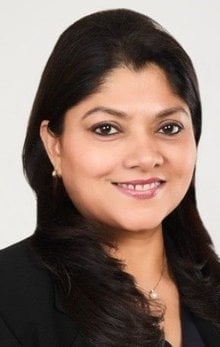
Vaishali Nigam Sinha
Co Founder and Chairperson Sustainability