
How Gulf States are Securing the AI Supply Chain
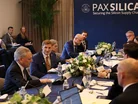
Qatar and the United Arab Emirates are set to join the US-led Pax Silica agreement, signalling a decisive pivot in Middle East industrial strategy from hydrocarbons to silicon and software.
Qatar formally entered on 12 January 2026, with the UAE due to sign on 15 January. They join a "coalition of capabilities" that includes the United Kingdom, the United States, Australia, Israel, Japan, Singapore and South Korea.
Gulf states enter the US-led "Silicon Declaration"
Pax Silica, commonly referred to as the "Silicon Declaration," is a strategic framework initiated under the Trump administration to reinforce semiconductor and AI supply chains. The name evokes Pax Romana whilst nodding to silica, the core material in chipmaking.
As Jacob Helberg, US Under-Secretary of State for Economic Affairs, explains: "If the 20th century ran on oil and steel, the 21st century is going to run on compute and minerals." For Gulf economies, participation signals a recalibration of economic and national security priorities.
Jacob frames this as a turn to "silicon statecraft," in which sovereign wealth and energy assets are used to secure positions in the digital economy.
Three bottlenecks: Minerals, compute and capital
Pax Silica targets three systemic vulnerabilities in the technology supply chain:
- Critical minerals: With China processing about 90% of rare earths, the pact seeks Western-aligned alternatives for materials essential to advanced chip production.
- Compute and power: AI data centres demand vast electricity with consumption expected to triple by 2030. Qatar and the UAE can underpin large-scale compute farms with their generation capacity.
- Capital deployment: The Qatar Investment Authority manages around US$524bn, whilst UAE sovereign funds manage more than US$1tn. These financial vehicles are already being channelled into ventures such as "Stargate," the US$500bn data centre project involving OpenAI and SoftBank, alongside a US$100bn collaboration between Abu Dhabi's MGX, BlackRock and Microsoft.

Ports, power and protected corridors
Beyond digital infrastructure, the agreement emphasises physical connectivity.
Upgrades to the India-Middle East-Europe Corridor aim to integrate US technology into ports, rail networks and undersea cables from India to Europe through the Gulf, creating a protected trade spine for high-value goods and data.
Pax Silica could also deepen economic interdependence between Israel and Gulf partners through shared industrial objectives, including the "Fort Foundry One" park in Israel and a 5 GW AI facility in Abu Dhabi.
The overarching goal is to secure technological advantage over rivals, particularly China.
Competitive edge and conditions on China Jacob says: "Our strategy is to create a competitive edge so steep, so insurmountable that no adversary or competitor can scale it." Membership does not demand full disengagement from Beijing but does come with conditions. In the UAE, G42 divested Chinese holdings to finalise its Microsoft partnership.
Although Pax Silica is a statement of "first principles" rather than a binding treaty, the capital committed suggests a realignment in motion. The contest for AI leadership now runs through the ports and data centres of Doha and Abu Dhabi.



Executives
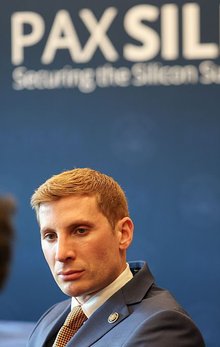
Jacob Helberg
US Under-Secretary of State for Economic Affairs