
Babcock's SME Strategy to Fortify Supply Chain Resilience

For Donna Sinnick, Chief Delivery Officer at Babcock International Group, the defence sector is more than a professional calling, it is a lifelong habitat. Raised in a military family before embarking on a three-decade career, Donna now directs Babcock’s global delivery, managing everything from cyber and IT to procurement and engineering.
“I grew up in that defence environment,” Donna reflects. “It wasn't a conscious decision to work here, but after an incredible career, it’s not something I would change.”
At the heart of Donna’s strategy is the belief that Small and Medium Enterprises (SMEs) are vital to operational resilience. By merging modern technology with localised expertise, Babcock is unlocking unique value within its supply chain.

In an industry such as defence, how does Babcock manage its supply chains?
Our supply chain is globally led, but it's locally delivered. So we believe that the closest to the customer and the closest to the supply chain is where it should be locally delivered. We're a massively diverse organisation with a significant global footprint. From Australia and New Zealand, Canada, France and South Africa, we are growing around the world.
We manage our supply chains as a global end-to-end supply chain, using different tools and technologies. Our procurement workforce delivers value and operational resilience, which is something that has always been critical but has become even more critical in the defence world that we sit in today. But what we do have are global centres of excellence, key functional delivery areas, working across all of our different programmes.
As global supply chains around the world shift, what is the role of responsible procurement in Babcock?
Responsible procurement is something we couldn't execute and deliver without. It’s fundamental in all that we do, it keeps us operating and ensures we're compliant with all the regulatory standards that are ever-evolving. It gives us our framework for quality assurance, corporate responsibility and sustainability. It's always odd when people have a perception that sustainability isn't at the forefront of our mind in a defence organisation, but it's absolutely critical to us. It drives us and it allows us to build and introduce things like our ten-point SME engagement charter that we've just released.
This is designed to enable, reshape and accelerate how the UK defence sector engages with Small-Medium sized enterprises (SMEs). The charter brings real, practical commitments – including proportionate contracts, faster payments, clearer engagement pathways and better support to help SMEs grow and scale with us.
Part of supply chain resilience and responsible procurement looks at the ways we sustain and develop smaller companies, but it's not just the charter. It's a commitment from us because we recognise through our procurement that what's important to a large company might be relevant to a small organisation. The public procurement process can be seen as lengthy, complex, expensive and at times, overly bureaucratic. Primes are able to operate in a Commercial manner, with agility and help SMEs overcome these barriers.
How have you found that SMEs play a role within the UK defence industry?
Ultimately, they are the lifeblood of British industries and 99% of UK employers, 60% of employees work somewhere within an SME community. They are absolutely vital to UK national security. If we think about technology, pace and innovation, there's a massive element that can be unlocked through the SME community that in defence, we should be unlocking and driving.
We support around 22,000 jobs across the UK supply chain and about a third of our spend is going to SMEs, so about 550 million per year into the small and medium enterprise organisations. But it's still really tough for them.
Only about 4% of UK defence expenditure is with small and medium enterprises. The 2025 Strategic Defence Review and Defence Industrial Strategy highlights the critical importance of integrating SMEs more effectively into the defence supply chain and how we need to collaborate to accelerate research, drive innovation and translate all of that into war fighting effect, quickly.
The introduction of our Babcock SME engagement charter will help to cut through the complexity, remove barriers, make it easier for SMEs to engage, innovate and contribute. That's the fundamental principle of it. It's got some real practical commitments in there. And really, we're driving for them to grow and scale with us. We did a body of research work called the Next Line of Defence with the University of Exeter, which looks at areas to strengthen the long-term resilience of our SMEs.
Could you share a case study of where SMEs have helped unlock value for Babcock?
In general SMEs unlock value for us across many activities. We've got more than 4,000 small and medium enterprises across our organisation and our supply chain and they create value for us every single day, whether that's a product that they bring or the creative thinking about how we can either integrate a product or move forward.
How is Babcock using modern technology to build operational resilience in a turbulent environment?
We work with some great third parties whilst developing our own internal capabilities, unlocking the many business advantages that the AI revolution is bringing about. We're developing our own AI solutions to help us cut through some of the information that we receive and help us seek solutions much more rapidly and much more in depth.
We're also creating our own supply chain dynamic risk management tool, which is supporting us with events and scenario planning and evaluating if we can respond to a worst-case risk. It allows us to scan the environment quickly and do real-time supply chain insights work. We have a global supply chain team whose responsibility it is to monitor for those threats and risks and to utilise the technology that we have to get those emerging risks understood, to think about our next steps, to think about the responses and then to mitigate the risks.
I'm sure there are stories of many scenario plans that no one thought would actually happen that are happening, so we're developing our own real thinking solutions and tools on that front.
SMEs are the lifeblood of British industries
What do you think the future of supply chain strategy looks like?
I would say that a supply chain has sometimes been seen as quite a tactical delivery function, whereas it's now moving or has moved to more of a strategic differentiator. We recognise supply chain resilience, the risk management and it is a significant risk to defence. But the future will be a more digitally enabled supply chain, rapid fact-based decisions, insight-led decisions rather than history-led, but really driving for those insights and decisions.
We're certainly looking for future growth. We're expanding further into territories that we haven't worked in before. That's a significant emphasis on due diligence, on making sure that our global centre truly understands local requirements and how different nations work and think. Cyber is obviously a huge focus for us, our customers, the government, all of the contracts that we work in. It's become a baseline expectation, but those requirements are increasing in the world and certainly on us.
Then unlocking the potential, those conscious direct inclusion of small and medium enterprises, because fundamentally, I think we are, as a nation, going to need to move with much greater supply chain pace.
Company portals

Executives
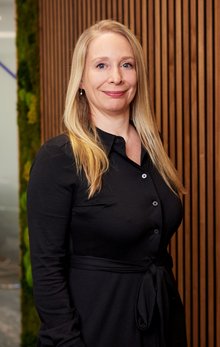
Donna Sinnick
Chief Delivery Officer