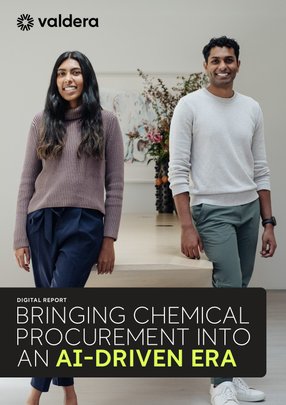
Valdera: Bringing Chemical Procurement Into an AI-Driven Era
Procurement leaders in chemicals and raw materials know the frustration intimately. You need a new supplier for a specialty additive, and your options are a decade-old contact list, a trade show from two years ago, or a search engine. Meanwhile, your R&D team is waiting, your launch timeline is slipping, and the CFO wants to know why you are still single-sourced on a critical input that represents millions in annual spend.
That gap between the complexity of global chemical sourcing and the primitive tools available to manage it is exactly what Valdera was built to close. But they’ve expanded upstream. Procurement teams are not just struggling to find suppliers; they are struggling to know where to focus their spend, how to read a volatile market, and when to act. In the few years since its founding, Valdera has gone from a thesis to an AI-powered procurement operating system trusted by some of the largest manufacturers in the world.
Born from a broken process
Valdera was founded in 2020 by siblings Sruti and Dheev Arulmani. Sruti, who serves as CEO, had seen firsthand how manufacturers, even massive ones with billion-dollar raw material budgets, were still sourcing chemicals through manual processes, outdated supplier databases, and word of mouth. The industry had digitised nearly every other function, but procurement of the actual inputs that make products was still stuck in a previous era.
"Every product that people interact with on a daily basis is made of chemicals and raw materials, but the industry has a massive gap when it comes to actually sourcing them intelligently," Sruti explains. "After COVID emptied shelves and geopolitical disruptions kept compounding, it became clear that the old ways of working just were not going to cut it anymore."
The timing was deliberate. The pandemic had exposed just how fragile single-threaded supply chains really were. Manufacturers who had relied on the same handful of suppliers for years suddenly found themselves scrambling, with no systematic way to identify, qualify, or engage alternatives at speed. Sruti and Dheev saw an opportunity to apply modern data science and AI to a problem that the industry had been brute-forcing for decades.
What Valdera actually does
Valdera is the AI operating system for chemical and raw material procurement. It is not a marketplace, and it is not a distributor. It is a workspace built around how procurement teams actually work—bringing together three integrated layers: category management to pinpoint where spend, risk, and opportunity sit; market intelligence to track pricing, supply, and trade signals without going to market; and a sourcing platform that matches buyers with qualified suppliers worldwide based on their exact material requirements. All three are powered by data science, machine learning, and AI, and built specifically for chemicals.
The scale of the platform tells the story. The platform's proprietary database maps over 400,000 suppliers and 1.7 million CAS numbers across 150 countries. When a procurement team is ready to source a material, Valdera's domain-trained AI matches them with the best-fit suppliers based on capability, geography, certifications, regulatory compliance, and pricing, then automates the RFQ process from first contact through to quote comparison.
The results have been substantial. Across its customer base, Valdera has delivered average cost savings of 14%, shortened product launch timelines by 30 to 40%, and enabled manufacturers to expand their qualified supplier networks by two to three times. For procurement leaders under pressure to reduce costs, derisk their supply base, and accelerate time to market, those numbers represent a step change from what was previously achievable.
"We help manufacturers transform their supply chain, whether the priority is speed, resiliency, sustainability, quality, or cost," says Sruti. "Traditional sourcing methods, like Googling one supplier at a time, just are not going to work in today's environment. The scale and complexity of the problem demands a fundamentally different approach.
"Almost everything we build is either helping our customers know the right thing, presented in a clean, human-readable way, or using AI to help them accomplish significantly more with the same size team," Sruti notes. "Every AI feature we ship has to deliver the same quality of insight a domain expert would produce by hand. If it does not clear that bar, we do not release it."
Built for how procurement actually works
What separates Valdera from generic supplier databases or broad-spectrum procurement tools is that the platform was designed from day one around the actual workflows of chemical & raw material sourcing teams. Mapping spend across hundreds of materials. Tracking pricing and supply movements across volatile global markets. Launching RFQs, managing multi-supplier engagement, sorting through technical documentation and compliance certifications. These tasks consume enormous amounts of a sourcing team's time and limit what they can strategically accomplish in a given quarter.
Valdera automates the low-value, high-volume steps so procurement leaders can redirect their time toward what actually moves the needle. Building durable supplier relationships. Managing supply chain risk. Driving strategic cost performance. The platform uses AI not to replace human judgment, but to eliminate the manual grind that prevents experienced teams from exercising that judgment at scale.
That same discipline shapes how Valdera itself is built. "One of the things that's timeless and true, probably for every founder, is prioritisation and knowing what's important," Sruti says. "We have to work really hard every day at every stage of the business to make sure we're working on the single most important thing for our customers, solving the highest-value problem and staying 100% focused on that."
"Almost everything we build is either helping our customers know the right thing, presented in a clean, human-readable way, or using AI to help them accomplish significantly more with the same size team," Sruti notes. "Every AI feature we ship has to deliver the same quality of insight a domain expert would produce by hand. If it does not clear that bar, we do not release it."
The customers and the credibility
Valdera's growing customer base includes some of the world's largest manufacturers, ranging from Fortune 500 industrial conglomerates to major consumer packaged goods and beauty brands. Companies like Toray Industries and Owens Corning are already seeing double-digit cost reductions, reduced supply chain risk, and significantly faster sourcing cycles. The platform's largest multinational customers spend more than US$10bn on raw materials annually.
John Eustis, SVP of Procurement at Toray Industries, describes the shift. "Prior to Valdera, finding the right suppliers was often a challenge. You never knew what you might find picking a supplier out of a marketplace or cold calling someone from a database. With Valdera, we can quickly get broader market insights and build relationships with vetted suppliers globally. The platform gives us a true global picture of the market for each specific material."
That credibility extends to the investment side. Valdera's US$15m Series A was led by Index Ventures, one of the most prominent technology investors in the world.
“One of the best things about having amazing investors around the table is that they're investing in some of the most cutting-edge technology and so we get to learn from each other,” explains Sruti.
AI that strengthens relationships, not replaces them
One of the most common misconceptions about AI-powered sourcing is that it aims to cut humans out of the loop. Valdera takes the opposite position.
"The chemicals industry is a relationships-based industry," Sruti says. "No one is going to make a million-dollar purchase on a fully automated platform, and there should not be an appetite for that. Business trust matters too much. Valdera does not remove the relationship between buyers and suppliers. We strengthen it by freeing both sides from manual work so they can invest their time in what actually builds lasting partnerships."
This philosophy extends to how the platform handles market intelligence. Valdera provides procurement teams with real-time insights on supplier capabilities, pricing trends, and geopolitical risk factors, giving them the information they need to make strategic decisions rather than reactive ones. When tariffs shift, trade routes change, or a key supplier faces disruption, Valdera helps teams respond with data rather than scramble with phone calls.
A collaborative approach to product development
Valdera's approach to building its platform is deeply collaborative. Customers are not just users. They are active partners in shaping the product roadmap. The company works directly with procurement teams to identify the highest-value problems and builds solutions around the realities of how those teams actually operate.
"Our customers are deeply involved," Sruti explains. "They are giving us ideas, we are giving them ideas, and we get in a room together to work through the biggest problems. Every single person on our team knows exactly what the most important outcome they are delivering is."
That customer-centric focus is reinforced by an investor base that brings operational expertise, not just capital. Index Ventures' portfolio includes some of the most transformative enterprise technology companies in the world, and the industry executives on Valdera's advisory board contribute direct procurement and supply chain experience at global scale.
What comes next
With Series A funding secured and a rapidly expanding customer base, Valdera is investing in deepening its AI capabilities, broadening its supplier database, and extending the space it plays in. The company operates in a US$5tn chemicals industry where even incremental improvements in sourcing efficiency translate to massive savings at scale.
For Sruti, the motivation has always been practical. "Our core mission is to make it easier for big manufacturers to make great products at scale. Buying the right inputs, at the right cost, at the best quality, with reduced risk. So that you and I can walk into a store and see quality products stay in stock at a reasonable price."
When asked what advice she would offer to other founders tackling entrenched industries, Sruti is characteristically direct. "Think about where people do not have enough information to make the right decision, and where they do not have the tools to execute. A lot of people call it too early. If the first principles are still true, see it through."
Valdera's story is not about disruption for its own sake. It is about giving procurement professionals the data, the tools, and the global visibility they need to do their jobs at a level that was simply not possible before. In an era of relentless supply chain volatility, that is a proposition that speaks for itself.