Take a large dollop of the famed Texas “think big” attitude, add more than a dash of Japanese innovation and top it off with vision and courage.
That is the recipe for something remarkable that is taking shape at Toyota Motor North America’s headquarters at Plano, Texas.
It started with a problem: for decades, the automotive industry viewed the supply chain as a series of back-office levers to move parts from point A to point B. However, as data and AI force themselves onto the stage, this attitude is a potential barrier to growth and competitiveness.
At TMNA, leaders decided to ditch the old model and design something better. By dismantling legacy silos and merging two distinct supply chains into a unified, data-driven ecosystem, the organisation is staying at the cutting edge – and making procurement and logistics the ultimate drivers of business resilience and customer satisfaction.
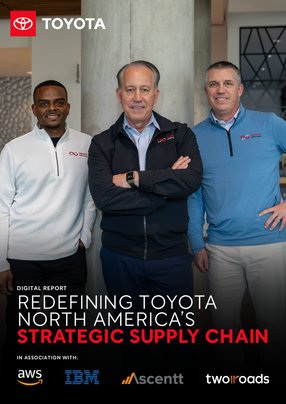
Speaking to Procurement Magazine, three senior TMNA executives explain how a strategic orchestration of talent, culture and digital intelligence is helping the business navigate a volatile global landscape and innovate at pace – supercharged by the digital age.
Two supply chains, one vision: unification
The history of Toyota in North America is a study in adaptation. Beginning in 1956 with a failed attempt to import Japanese vehicles that could not handle American highway speeds, the company spent the next 30 years building a robust distribution and dealer network. When the move to "build where we sell" occurred in the mid-1980s, it necessitated the birth of a second, entirely separate supply chain for manufacturing.
As Chris Nielsen, Executive VP, Chief Supply Chain Officer & Chief Quality Officer, TMNA, explains: "For a really long period of time, we had two really separate companies, one headquartered in the West Coast, one in the Midwest, one a sales and service organisation, one a manufacturing and engineering organisation.
“So we really had two supply chains operating. Even in many cases, we had the same supplier. We were interfacing with them differently and parts were flowing quite differently."
The decision to unify these affiliates in 2014 was the catalyst for the current transformation. By bringing the organisations together in Plano, Texas, Chris and his team began to realise that unification offered more than just administrative efficiency; it offered the opportunity to serve the "ultimate customer" – the consumer – through a single, cohesive vision.
He says: “The old systems certainly had their strengths in terms of being very focused on the customers they were serving, yet I don't think they really served the ultimate customer, the consumer, as best they could.
“So by coming together, I think it really allowed us to have one vision of what was really necessary to serve that ultimate customer.”
Kevin Austin, GVP of Supply Chain Strategy & Operations, expands on the issue: “With any purchase, you want to be able to make this trade-off between the price, the choice and then when you can get it.
“So a customer wants to have the power to determine that trade-off themselves. To do that, that is really a supply chain answer. To present the consumer with that choice and be able to trade off, "I want this vehicle with this spec, I can get it here," requires such integration across the supply chain that we were not able to deliver when we had this fragmented world of two different supply chains.”
He adds: “So a lot of our story is really to be of service to the dealer, to be of service to the end customer. And the only way we can do that is by integration, end-to-end data connectivity and really operating as one team.”
From pilot purgatory to digital-first operations
In any large-scale manufacturing environment, the temptation to chase the "shiny object" of new technology is immense. Many organisations fall into a trap of fragmented digital experiments that fail to scale. Kevin refers to this as "pilot purgatory".
"We were trying to do a lot of pilot initiatives, but we got stuck in this world of pilot purgatory and couldn’t get ourselves out," Kevin admits. To break free, TMNA shifted its focus from isolated tools to a holistic ecosystem.
The leadership team identified a "North Star" – a clear hypothesis of how data and AI could add value to three key stakeholders: the customers, the team members and the company’s bottom line.
The solution was the development of a central data integration layer – a platform that connects digital products and AI to real-world workflows. Starting with the planning arena, TMNA connected market needs with supply capabilities.
This data-driven approach has stripped out vast amounts of non-value-added work. By integrating end-to-end data connectivity, the company has minimised customer friction and translated digital efficiency into tangible revenue.
The digital evolution of the Toyota Production System (TPS)
The Toyota Production System (TPS) is one of the best-known management philosophies in manufacturing history. Traditionally associated with the factory floor and the elimination of waste, TPS is being redefined for the digital age. Rather than being seen as a rigid set of manual tools, it is now viewed as a system for empowering people to solve problems at digital speeds.
Chris describes the translation as seamless: "Digitalisation in a lot of ways adds speed, right? It allows us to diagnose problems, analyse, collect the data that would be needed to analyse a process to identify where are the weak points, where are the things we need to improve?
“So we feel like, as we're beginning to digitalise TPS tools, for example, it's allowing us to move even faster than we have in the past."
This digital version of TPS maintains a human-centric core. Kevin says that, while it is easy to see physical flow in a warehouse, observing a business process that spans months and multiple geographies is harder.
Digital capabilities bring "observability" to these invisible workflows. By creating feedback loops – such as using consumer search data to refine forecasts rather than relying on historical sales – Toyota can see "true demand" and adjust the entire supply chain accordingly.
Building two-way connectivity with suppliers
On a typical vehicle, 75% of the content is outsourced, and there are over 1,000 locations just within North America that receive demand signals.
Ryan Grimm, Group Vice President, Toyota Purchasing Supplier Development, says: “So the integration with the suppliers and their ability or buy-in to come along on this and support this is absolutely critical.”
Ryan emphasises that partnerships are foundational to Toyota’s success. The organisation has moved beyond "demand signals" toward what it calls "two-way supplier connectivity".
Historically, a manufacturer might send a demand signal and hope for the best. Today, the TMNA platform allows for real-time integration. Kevin provides a compelling example involving an interior trim supplier. The system flagged a demand spike eight weeks before it became a crisis.
"The supplier kind of got notified through the system eight weeks before there was an actual problem and the beauty is what that eight weeks was able to buy us," Kevin says. "It bought us time and we were able to proactively countermeasure it.
“Without that, we would have been parking vehicles. We would have had to call customers and tell them, 'Hey, you can't get your car when we promised you’." This proactive approach is the difference between a reactive, painful supply chain and one that maintains flow through transparency.
Driving transformation through shared vision
From the very beginning, Toyota's founders understood that partnership was central to building something durable. That belief lives on today in the way Toyota engages with its suppliers and dealers, and in how the company has chosen to approach the transformation of its supply chain.
To deliver a transformation of this scale, Toyota knew it couldn't go it alone. The company deliberately partnered with others who brought specific domain expertise and outside-in perspective – and paired that with a sustained investment in building its own internal capability, because the muscles required to run a modern supply chain have to live inside Toyota.
The challenge TMNA set out to solve is not trivial. The company is operating on a foundation of legacy systems and mainframe applications that have served as the transactional backbone of the enterprise for decades. The mandate, therefore, has been a dual one: modernise that foundation while simultaneously reimagining the work itself through AI. Most companies attempt one or the other. Toyota is doing both, on purpose, at the same time – because separating them would have produced a faster answer and a far weaker one.
To push this forward, Toyota has collaborated with a wide ecosystem of partners – hyperscalers, enterprise software providers, AI specialists and focused domain firms, including AWS, IBM and many others. The relationships are structured around a consistent principle: partners bring scale and specialty capability; Toyota owns the architecture, the domain intelligence and the outcomes. Partners have been engaged across every layer of the new stack and across the full product development lifecycle of each use case – so the work is genuinely co-created, but the accountability for what gets built, and what it delivers, stays with Toyota.
A clear example is Toyota's supply chain digital twin. Built on the foundations of the company's CUBE platform, the digital twin provides a live, end-to-end view of the network, from supplier capacity to plant build plans to logistics flows to dealer demand, and the ability to simulate decisions before they are made. It was developed in collaboration with multiple partners across the data, modelling and visualisation layers, but it is operated and extended by Toyota team members, against Toyota's standards, on Toyota's data. That is the model in microcosm: outside expertise, in-house ownership, durable capability.
The most consequential outcome is not any single use case. It is that Toyota has built platform capabilities, CUBE is the clearest example, that will continue to scale into new domains, drive the next wave of innovation and develop the workforce for the future. The company is not just delivering value today. It is building the operating system on which the next decade of Toyota's supply chain advantage will be built.
Resilience in global and regional headwinds
The current global environment is fraught with disruption, from trade friction and tariffs to geopolitical instability in the Middle East. For Ryan, resilience is built through information and trust. "Part of this whole journey, not only connecting, is also for us to continue to get more information from our suppliers," he says.
TMNA is engaging in extensive mapping of its supply chains. While this began as a compliance exercise, it has evolved into a strategic risk management tool. By mapping the "supply chains of the suppliers", Toyota can identify risks in raw materials or semiconductors long before they halt production.
Chris provides context on the regional footprint, saying: "In North America, about 80% of the vehicles that we sell are produced here... Everything we produce in Canada and Mexico is compliant with USMCA."
Despite this heavy domestic presence, with domestic purchases north of US$50bn in parts annually, the company takes proactive steps to mitigate global shocks as well. The data-sharing ecosystem ensures that when a supplier struggles, Toyota can go in and support them, rooted in a foundation of "mutual trust and mutual benefit".
Cultural alignment: respect for people and continuous improvement
A supply chain transformation is only as strong as the people executing it. At Toyota, the cultural framework – the "Toyota Way" – is built on two pillars: respect for people and continuous improvement. In an industry known for volatility, TMNA’s commitment to its workforce is singular; the company has famously never had a layoff in North America.
This builds an "incredible bank of trust," according to Chris. Team members feel secure enough to take risks and fail during the transformation. This culture has allowed employees who have been with the company for decades to transition from traditional roles into high-tech positions, such as digital product owners.
Ryan says that the leadership is intentional about giving people "time to think". The organisation actively debates how much time should be allocated for employees to pursue continuous improvement outside their daily tasks. "You've got your job to do, but at the same time, you should also have time available to think, to improve, right? That’s fundamental to who we are and how we operate," he adds.
Bridging the mindset gap: leadership evolution
Perhaps the biggest barrier to supply chain transformation is not technology, but mindset. Kevin reflects on his evolution as a leader, admitting that he once viewed business strategy and technology strategy as two separate entities.
"I used to have this belief that business strategy and tech strategy were two different things... As the world has evolved and as technology's evolved, leadership is really requiring one to have a deep sense of both."
The challenge is to simultaneously maintain a deep connection to the legacy "Toyota Way" while approaching problems with a blank sheet of paper. By shifting from a "know-it-all" culture to a "learn-it-all" culture, TMNA is fostering a growth mindset across its 6,500-strong headquarters.
The forward-looking roadmap: 12–24 months
As TMNA looks toward the next two years, the focus remains on scaling the capabilities built in the planning arena across the rest of the value chain. This includes further integration into service parts, quality management and the dealer network.
The "Lighthouse" initiative – an innovation zone where dealers test new digital products in real-world sales environments – is a prime example of how these tools are being scaled nationwide.
The roadmap is clear: continue investing in AI and data integration to amplify human potential. By simplifying workflows and stripping out non-value-added steps, Toyota is not just building more efficient vehicles; it is creating joy in the workplace by giving team members the space to make a meaningful impact.
As Kevin concludes: "If you can make your culture and your team and even yourself as a leader recognise the power of change, but also the power of curiosity and learning, then candidly anything's possible."
The Toyota case study is a masterclass in how to turn a complex, fragmented operation into a seamless, strategic engine of the future.
Company portals
Executives
Chris Nielsen
Executive Vice President, Chief Supply Chain & Chief Quality Officer
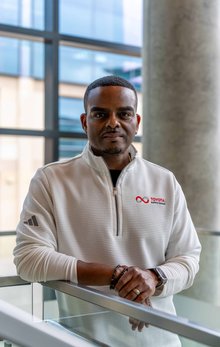
Kevin Austin
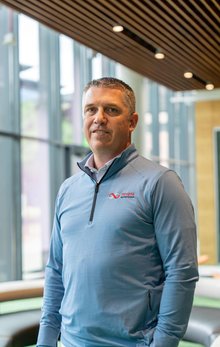
Ryan Grimm
Group Vice President, Toyota Purchasing Supplier Development