
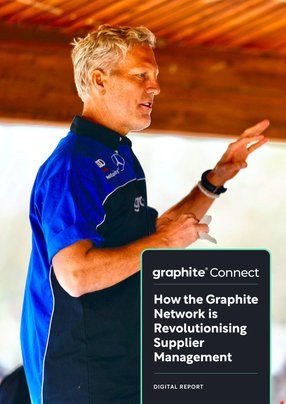
How Graphite Connect is Revolutionising Supplier Management
The traditional methods of supplier information management can plague organisations with inefficiencies, fraud risks and wasted resources. Conrad Smith, Founder and CEO of Graphite Connect, says his company's network architecture can fundamentally transform how procurement teams manage suppliers & their data.
Graphite Connect has grown to approximately 100 employees, split between the United States and international operations across Europe, the Americas and Asia. The company was built with a strong engineering foundation to ensure scalability while maintaining real-time capabilities.
"When we built the business, we wanted to have the best of the best close by so that we could rapidly grow the technology and be prepared for the future and winning the network," Conrad explains. "Having just exceptional engineering and architecture, so we didn't have to backtrack a bunch of stuff was really important."
What distinguishes Graphite from other procurement technology providers is its team composition. "We are a strong engineering team, but that's balanced also with procurement people. We're built by procurement, for procurement," Conrad emphasises – ensuring current customers see Graphite as more than just a supplier management platform, but a partner in solving their procurement transformation.
‘LinkedIn for procurement’: The genesis of Graphite
The genesis of Graphite Connect came from an unexpected source — Conrad's reflection on missed opportunities in the social networking space.
"Seeing Facebook and LinkedIn and these other social networks, I asked myself, why didn't I think about applying networks in these other unique ways?" he recalls.
This contemplation led him to a big idea – LinkedIn for procurement – a network of supplier-managed profiles that could easily be shared and drive significant efficiency for suppliers and procurement teams. "I started clicking through the greenfield opportunities to what other social networks don't exist. And as I did that, I thought, there's really no social network that connects businesses together."
"The opportunity to create a new social network and the problem of sharing in a really scalable way, the seller information with the buyer information, those kind of came together and it was almost like this major light bulb moment," he explains.
That “light bulb” was the initial idea for Graphite, which has grown significantly since its founding in 2018.
Breaking free from the analogue
Conrad, who prior to founding Graphite worked as head of procurement at Adobe & Omniture, highlights how procurement continues to operate with outdated methodologies despite technological advances. "One of my biggest disappointments in 30 years in procurement is how much of this stuff we're still doing the same way," he shares.
The traditional approach to supplier information involves procurement teams collecting data point by point from suppliers — a process rife with inefficiencies. The explosion of risk and regulatory requirements in the last decade have exponentially increased these inefficiencies, bogging down procurement and risk teams and inhibiting their ability to add strategic value to their business partners. When obtaining documents like certificates of insurance, Conrad notes: "I've now got a monkey on my back — who's going to remember to go back and talk to the supplier to get this new updated certificate of insurance next month?"
Graphite's innovation comes from recognising this boom in supplier data collection and the distinction between the data required for strategic supplier management versus purely transactional procurement.
"Traditional procurement networks are transactional. I have a PO for you, you have an invoice for me, I have a payment for you. By definition, this is one-to-one," Conrad explains.
In contrast, holistic supplier management — risk management, contract management, performance management and innovation — requires a different approach with a true 360-degree view of supplier's data.
Basic supplier information like addresses, tax details and banking information — which previously required individual updating across multiple systems — can now be maintained in a single location with updates cascading to all connected partners.
"As I update my certificate of insurance for you, it's updated for all of my other connected partners as well," Conrad says. "I've actually talked to companies that have decided not to move their offices because of the headache of telling all their customers about their office address change."
The cost of bad data
Supplier data quality forms the foundation of effective procurement, according to Conrad. He draws a parallel to Maslow's hierarchy of needs: "Every higher value activity that you want to do in procurement is building on the level of Maslow's hierarchy below it, and it all sits on top of that data."
Bad data creates ripple effects throughout procurement operations: "You get tremendous inefficiency. You've got supplier support problems, you've got communication problems. You don't know who the contacts are, you probably don't even know who at your business is using the supplier."
These data weaknesses create security vulnerabilities as well. "These soft spots in the process and the data are just a wide open door to vendor fraud," Conrad warns. Highlighting that AI advancements have made phishing attacks more sophisticated, he continues: "Anybody anywhere can put their badly spelled phishing attack into some AI tool and have it look like it was written by someone that came out of Stanford."
Graphite's latest innovation in fraud prevention leverages the power of the network and shared suppliers — similar to how social networks naturally flag false information through collective oversight.
"Imagine if I went and updated my LinkedIn tomorrow and said, 'Hey, I got my MBA from Harvard.' I don't imagine it would take longer than about 24 hours for people to throw up the red flag on me," Conrad explains.
This community verification combines with technological safeguards to enhance security.
Graphite’s buyers transact billions of dollars in payments annually based on Graphite’s commercial data. By integrating data points like which supplier bank accounts have been successfully used by other companies in the Graphite network and when, teams can feel confident that they’re submitting payments to the right account. Positive bank account verification can also serve as an override, allowing trusted accounts to bypass other security checks.
"When a supplier shows up with a bank account change, or an entry submission of data that doesn't line up with what we already know about them, then that's red flagged immediately as a high-risk activity."
The system's value increases with each new participant: "Every new supplier that comes in expands the scope of the protection that the network provides."
AI in supplier management
Graphite is leveraging artificial intelligence across three primary dimensions.
First, AI helps suppliers populate their profiles more efficiently: "AI is helping us get the data into the profiles faster and keep it up to date better. So streamlining it for the supplier so the supplier can simply upload documents and then those documents can translate into their profiles."
Second, it enhances buyers' ability to analyse supplier information: "We've now used AI to be able to look at text-based answers and documents in order to evaluate the text and not just the yes or no or multiple choice kinds of questions and provide sentiment, extract metadata, summarise documents." Those insights can then be used to kick off projects like a risk assessment when a SOC report changes, or a renegotiation when a contract is coming up for renewal.
Finally, Graphite’s natural-language model AI improves search capabilities and insights across the entire supplier database: "When you put AI over the top of this dataset of all of your suppliers, your search works better and you can extract insights lightning fast."
Proving the network effect: Industry micro-networks
Graphite has found particular success by focusing on vertical markets with overlapping supplier bases. Conrad cites Paramount as an example of a company that benefited from consolidating vendor data across multiple ERPs following the merger of Viacom CBS and Paramount.
This success creates a virtuous cycle where satisfied customers advocate for wider network adoption: "Every new person, every new company that comes into that micro network or that vertical network brings value."
Through tracking the network, there are now more than a million updates per month to supplier data in the network. Every time a procurement team wants to connect with an active Graphite supplier, it’s exceptionally fast – 1-3 days on average — because that supplier’s data is already accessible and easily shared.
"Through all of that, this vendor onboarding and vendor process has brought faster, better, safer and more secure data with fewer resources required on their side," Conrad notes. The value proposition is compelling: "80% reduction in the time that it takes to go through the supplier onboarding process."
To support implementation, Graphite partners with services firms like Wonder Services, led by Amanda Prochaska. "She's bringing scale, efficiency and quality to the projects that we're implementing with our customers," Conrad explains, noting their expertise in change management and procurement technology implementation.
The future of supplier management
Conrad envisions continued growth powered by AI advancements and deeper integration with other procurement technologies.
"Graphite data is a unique data set that's proprietary. You can't publicly go find all this data and scrape the internet and bring it all together," he notes, highlighting how this proprietary data enhances AI capabilities for procurement teams. For example, genAI tools have become helpful for sourcing new vendors to initiate an RFP since product coverage is easily accessible and shared publicly. But when compliance requirements are high, pre-vetting vendors with their Graphite profile, which includes InfoSec, DORA, CSRD, GDPR and SOC documentation already, becomes much easier and ensures vendor selection moves swiftly.
He forecasts dramatic network expansion: "I expect in the next five years the Graphite Network is going to be 10 or maybe 20 times larger than what it is today and it really will become the source of supplier data for everybody."
Conrad's ultimate vision is the elimination of redundant questionnaires and data collection: "This will be the future where questionnaires don't matter anymore. They go away and it's just connecting. It's just connections, it's just profiles."
For procurement teams still struggling with spreadsheets, emails and the constant chase for updated supplier information, that future can't come soon enough.
BOXOUT 1: Paramount x Graphite
Tracey Walton serves as SVP at Paramount, overseeing the global procure-to-pay process and accounts payable across Viacom, CBS and Paramount. Her primary responsibility is ensuring suppliers are efficiently onboarded and paid whilst driving continuous improvement.
For Tracey, "effective supplier management is the starting point for my job." Without a streamlined, user-friendly onboarding process, Paramount would miss crucial opportunities—particularly critical in media production.
"If you don't have an effective supplier management process," Tracey explains, "you're looking at increased internal resource time and potentially even additional resources just to get suppliers onboarded. If you don't have that solid process, then you lose out on better negotiations with suppliers regarding pricing and payment terms. Most importantly, overall satisfaction for everyone involved in the process is why supplier management is so important to me."
Paramount and Graphite launched their partnership in 2023 after 18 months of preparation. "They've been spot on the entire time—with the customer service, the knowledge, the assistance in building our integrations—everything. It's been amazing," says Tracey. "Most importantly, with Graphite, our partnership has been truly focused on how we make things better and easier for our suppliers, specifically within media and entertainment, collaborating with other media and entertainment clients to ensure we have a process that works across the industry."
The most significant benefit has been dramatically reducing supplier onboarding time by transforming a complicated process into a simpler one. "Graphite helped us design questionnaires for our suppliers and workflows that allowed the tax departments and risk management teams to become more involved in the process. Graphite has made the process overall just better."
While Graphite's well-designed workflows, flexibility and bank verification stand out, its customer service has been exceptional. "That was hugely important," Tracey notes. "We want a tool that onboards our suppliers, validates bank information, does ID verification and protects personal information. But, more importantly, we want a tool and a company that can provide amazing customer service—and they do that for us."
The partnership aims to continue long-term, enhancing collaboration within the media and entertainment industry by creating more efficient, standardised supplier onboarding processes tailored to the industry's unique needs, such as onboarding talent.
BOXOUT ENDS
Boxout 2: Wonder Services x Graphite
Amanda Prochaska founded Wonder Services six years ago after identifying a critical gap in procurement processes. With 16 years of experience leading large-scale transformations, she noticed a recurring challenge: while procurement was finally receiving funding for technology implementation and organisational changes, change adoption remained a persistent struggle.
As Chief Wonder Officer, Amanda established Wonder Services to address this fundamental problem, offering both change management and procurement strategy services.
Procurement has evolved significantly from its cost-focused origins. Amanda explains: "As more focus started being put into how we manage our supply chains more effectively, gain more agility and reduce risk, a lot more focus was put into procurement around how we are managing our third-party suppliers."
She compares supplier management to employee management, emphasising the wealth of knowledg1e suppliers possess. "If you understand that your suppliers probably know more about the market than you do, they know the dynamics and risks that are out there, how do you tap into that to not only mitigate risk, but maybe even drive innovation?"
The collaboration between Wonder Services and Graphite Connect, a supplier onboarding platform, stems from shared values around customer experience. "When I came across Graphite, they were changing the game around how suppliers are onboarded into these massive companies," says Amanda. "They were very innovative and had proven results – even early on."
This partnership combines Wonder Services' expertise in change management with Graphite Connect's innovative technology, creating a powerful implementation model. While Graphite's technology can be implemented in as little as 10 weeks, adoption remains the primary challenge.
"The challenge is, how do you get your teams to adopt that change? How do you get your suppliers onboarded? All of that work is where we help Graphite," Amanda explains.
Wonder Services contributes project management skills, process flow mapping and change adoption practices to complement Graphite Connect's technological capabilities. Amanda is particularly excited about developing deeper technical capabilities as their partnership evolves.
"I can't wait to continue developing alongside Graphite as they roll out and expand their technology footprint," Amanda concludes.
Explore the latest edition of Procurement Magazine and be part of the conversation at our global conference series, Procurement & Supply Chain LIVE.
Discover all our upcoming events and secure your tickets today.
Procurement Magazine is a BizClik brand
Company portals

Executives

Conrad Smith
Founder and CEO