Leading Through Disruption: Procurement’s Green Journey
As geopolitical instability, supply chain disruption and mounting climate pressures reshape the corporate landscape, the leaders driving sustainability and procurement agendas have never been more strategically vital.
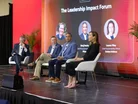
At Procurement & Supply Chain LIVE: The US Summit, three senior executives — Noel Anderson, Chief Sustainability Officer at the American Red Cross; Lauren Riley, Chief Sustainability Officer at United Airlines; and Sirsij Peshin, Chief Procurement Officer at Pfizer — discussed how their organisations are navigating an era of profound uncertainty.
From embedding sustainability within corporate strategy to building resilient supply chains and developing the next generation of leaders, they share the lessons, priorities and convictions shaping leadership today.

Could you each introduce yourselves and share the major leadership themes shaping your organisations right now?
Lauren: Well, let's be clear, it's an interesting time, but it’s also very confusing. We don't know what tomorrow brings. But I would encourage you all to think about the fact that disruption really presents opportunity, and our jobs are to figure out how to strike when disruption occurs in a manner that allows us to progress a low-carbon future.
Today we do have challenges — you can read it in the news anywhere — with sourcing jet fuel in some markets. What's interesting to me, as the Chief Sustainability Officer, is that suddenly we have a very different business case when it comes to sourcing sustainable aviation fuels. SAF — that's what we call it — is anywhere from two to four times the cost of conventional jet fuel.
Very, very expensive when you're looking at a company like United that has single-digit margins on a good day. So we have to find a way to make it relevant to the business.
We now have an opportunity because of this disruption to present sustainable fuel supply chains into our operation in a manner that we didn't before. And so we become a solution to the operation itself. We are diversifying supply chains. Take advantage of these disruptions so that you can strategically advance the agenda towards a future that is low-carbon.
“Disruption really presents opportunity, and our jobs are to figure out how to strike when disruption occurs in a manner that allows us to progress a low-carbon future ”
Noel: I'd add really quickly — I love that answer. I think that's a great answer. And I think it's also important to recognise that we're not in this on our own. I've found that my peers, other companies and other nonprofits are willing to help us through these challenges.
I think that suppliers and others recognise the need for us to try to evolve and get to that next step. And I feel like it's a journey that we're all on together and we're trying to find the right answers.
Sirsij: I would also echo that. And Lauren, clearly, if you're in procurement and supply chain today, this is probably the best time to be in that seat, where you're able to influence the business and the broader environment.
COVID happened, unfortunately, but it taught us what to do when a crisis hits. And I think what we are facing today is no less than COVID, but we've had those couple of iterations before, and as teams, we know how to address some of the challenges that geopolitics and tariffs drive for the world.
Bringing it back to Pfizer, there are a couple of things I find really impressive. One is from a responsible business growth perspective, we don't call it ESG, we call it responsible business growth.
It really is driven at the board level, and there is a board commitment to delivering on those targets. What I'm really proud of is that over the last couple of years, we have delivered US$4bn of aggregate spend towards small businesses across the world, which is phenomenal and is really impacting broader communities.
We are also overachieving many of our suppliers' science-based targets — 70% of our suppliers by spend now have an SBTi goal. What I'm trying to get to is that in order to have that impact, you need not just sponsorship but a framework that starts with governance, tools, commitment and change management, so that we are, as an enterprise, driving the agenda towards where we want to be.
In the last seven years of chaos, to what extent have your challenges changed, and how have you been able to leverage your position to influence the board to achieve outcomes that perhaps they hadn't imagined?
Noel: I think it's easier for me than it is probably for my colleagues, because we are simply seeing it firsthand, it's right in front of our faces. We went from responding to a couple of billion-dollar disasters a year to responding to multiple billion-dollar disasters at the same time, constantly.
It's not an occasional blue-sky moment for us anymore; it's a constant in our disaster response. And so we had to reimagine what that looked like. We had to ensure we had the capacity to deliver the mission we needed to deliver. In doing that, it became obvious across every other part of our organisation that we needed to be more sustainable, that we needed to work with procurement and supply chain to ensure that our partners were on this journey with us.
“It's not an occasional blue-sky moment for us anymore; it's a constant in our disaster response. ”
Sirsij: Challenges will continue to evolve; there will be external forces that drive businesses, as well as internal drivers. I think our role as leaders is to make sure the sustainability agenda stays on the agenda.
That's the commitment, lean in, be proactive, bring data to the table and say, here is what is possible and here is why it is critical for the business. We also constantly evolve our focus, for example, if capital is not available, can we focus on other areas of investment that are not capital-intensive in order to deliver on our sustainability targets?
I think one of the biggest opportunities, and an area where we need to do a lot more, is supplier discovery. How do we engage the right suppliers, particularly beyond the US, that bring in cleaner energy and cleaner technology? That's a challenge we have today, but I'm very proud of how we have evolved as a company over the last seven to eight years on the responsible business growth agenda, it's embedded in the business.
Lauren: I've been at United for about seven years. When I joined, sustainability and environmental impact were somewhat in isolation from the business.
We were the special projects team. Were we in the boardroom? Probably not as much as we should have been. Was it aligned to strategy? Probably not as much as it should have been.
Then we moved to what I call the kitchen sink phase, do everything as best you can in every capacity. And so now we're in a third phase that I call the pragmatic phase. This is really about anchoring sustainability in your corporate strategy.
Because the reality is, if you're not able to embed sustainability in a sustained manner within your business imperatives, it's going to be short-lived. I'm somewhat appreciative of this moment in time, albeit it's a little different. It has fostered a discussion in the boardroom about the crucial nature of sustainability in building a future that allows us to be competitive. It is anchored in our business strategy and it's not going anywhere.
It's about United leading, and leading on behalf of the industry, because everyone else is watching. And that to me is the most important thing we can do. The executive sponsorship is very real. Our CEO, he is a self-proclaimed climate science nerd. It's fantastic. He understands the challenges, he understands the opportunity, and he gives us the space to really go about building this correctly.
But we still have to make money at the end of the day. So my job is to figure out how we advance our agenda in a manner that works with the business, such that this conversation becomes business as usual in the decade to come.
“This is really about anchoring sustainability in your corporate strategy ”
Noel: I would just add that it is critically important to have our executive leadership and our board engaged, but I don't want us to lose sight of having our entire workforce just as engaged, and finding ways to make sure they feel part of this journey and feel ownership in this space.
Sirsij: I'd also add that procurement and supply chain is a team sport. It's critically important that we bring our suppliers along on the journey. Supply partnerships, as well as elevating your own team's capability, are key to driving the agenda forward.
“I don't want us to lose sight of having our entire workforce just as engaged, and finding ways to make sure they feel part of this journey ”
Bearing in mind the increasing leverage that procurement, supply and sustainability now have at the board level, how have you changed the way you're bringing your people forward and supporting them?
Noel: It's finding new and creative ways to keep them engaged in the process, finding ways that they feel part of it and are educated in it. I wish there were a single answer to that, but I think it's a multifaceted approach.
One important element for us is having the right relationships internally with procurement and supply management. I think we're lucky to have that at the American Red Cross.
Our supply management team even created a sustainable supply management position — that person allows us to have somebody in another part of the business who feels part of the sustainability team, and allows us to engage supply management in a whole different way than we had before.
It means this isn't just a sustainability office pushing information across the board, it's all entities having a slice of the pie and having ownership to work on the same strategy that we're all bought into.
Sirsij: Investing in upskilling and reskilling your team is critical. The beauty of it is that there is an agenda which I didn't have to push, because people in my team recognise this is something we need to do. We have an enterprise commitment towards our responsible business growth goals.
What I found interesting is that when you start tracking, reporting and making it visible, when one business unit is doing better than another, it's a powerful dynamic, because every business wants to outperform the others.
By doing that, you not only elevate what is possible, you also provide support and say, here is how I can help, and that's where our teams lean in and bring in either suppliers or internal resources to elevate the agenda and correct the course if required.
Tracking and reporting, as well as bringing the business into the conversation early, are key. We don't want to make it about shame or fame; it's about driving visibility. That was a challenge five years ago, but today people know we're committed at the enterprise level, and the board is tracking it, so everybody is bought in.
“We don't want to make it about shame or fame; it's about driving visibility ”
Lauren: I'll take it from a slightly different angle. I often get asked: how do I get into this career path, how do I find a role like yours or on your team? What's really exciting about sustainability and environmental impact is that it is a multifunctional discipline.
I work with people in government affairs and policy; I work with people in finance; I'm lockstep with our controller on disclosure; I'm talking to communications all the time about messaging; I'm talking to our venture team, looking at innovation and solutions; I'm talking to brilliant engineers with deep discipline in their unique spaces. This is a fully multifunctional career path.
I encourage everyone to think about what is within their scope and what they are empowered to do, because it's almost everyone across any enterprise or organisation who has the ability to choose a lower-impact alternative, to advance education, or to upskill. All of that is really, really important to continue to evolve such that we move towards a low-carbon, low-impact economy over time.
“If you're in procurement and supply chain today, this is probably the best time to be in that seat, where you're able to influence the business and the broader environment ”
You are actively building this work and doing it inside organisations at a moment when there is significant political pushback and backlash. What is the internal narrative that you've had to confront, not only to drive change in your organisation but within yourselves, to keep this work moving forward?
Sirsij: It's a personal journey for all of us, and we learn. My biggest advocates are my two boys. In schools, they started talking about the ESG agenda quite a bit, and they were my first sounding boards, asking: "Dad, what are you guys doing within the company to change the agenda?" This was 10 or 11 years ago.
What I found inspirational was that our own company gave me the flexibility to learn more, to go outside, to attend certification programmes, and by doing that, I became more equipped to understand what this means for the world.
And then you become an advocate. I constantly tried to show my presence not just within the company but outside it, asking why things are done a certain way, what it means for the sustainability agenda overall.
It's constant learning. I'm still learning, and one area where I'd love to do more is understanding what is happening in the AI world that could give me a real-time view of what's happening across the world in the sustainability space. It's a journey.
But I'd probably give credit to my boys. If they hadn't asked the question 10 or 11 years ago, I might not be here. Procurement taught me to be more humble and more responsible, and for that I'm grateful.
“Procurement taught me to be more humble and more responsible, and for that I'm grateful. ”
Lauren Riley: I'm generally an optimist, though I think I'm much more of a pragmatic optimist today. I think we sometimes conflate politics with policy and opportunity, and we need to disassociate the two.
My north star at this moment is really recognising that it is this generation of leaders who have the obligation to do this right now.
Because it's going to be generation after generation that looks back at us and asks: Did we do this with integrity? We have an extraordinary opportunity, politics aside, to do what's right and to benefit future generations to come.
And if we mess it up, it's on us. I take that very seriously. So the noise, in a sense, doesn't matter; I'm anchored in building for long-term change and that's what's important to me.
“We sometimes conflate politics with policy and opportunity, and we need to disassociate the two ”
How are you thinking about balancing immediate supplier needs, such as sourcing fuel alternatives right now, with developing future talent pipelines and partnerships with universities and emerging institutions?
Noel: It starts with planning. You've got to build out frameworks and ensure you understand what your future looks like, not a one-year future. For us, we have plans through 2050. Obviously, those aren't very detailed that far out, but we know what the path is going to be.
The short-term challenge is ensuring the mission continues to be delivered in the most sustainable way possible. That means perhaps not implementing the ideal solution immediately, but having a vision of what we can do right now to reduce as much as possible in the short term.
Lauren: Partnerships are really, really important. When we're in the business of establishing a foundation for the future, we need to make sure we have collective voices at the table to enable decisions around what is right, what is sustainable and what is low impact.
If you ask a company like United alone, of course, we'll have a very industry-specific perspective. What we want is a much broader perspective, with nonprofits, academia and other suppliers, to understand what is within the realm of the possible, and then how do we take it just a step further.
Sirsij: I'd add, anchor around the why behind the what. Our supply partnerships and any partnerships from a broader responsible business growth perspective are around product innovation, equitable access and pricing and driving the diversity and inclusion agenda across the company.
There are elements of the broader programme that are governed at board level and we are challenged to find the right partnerships, whether with academic institutions or suppliers.
We have what we call a supplier discovery and development programme, where we actually bring a supplier on board and, if support is needed, help that supplier grow with us.

Are you happy with the way you're developing opportunities for women leaders in your organisation, and what needs to be done?
Lauren: Part of my other role is helping lead United's employee resource group for women. It's really important to recognise that we have to lift each other up and acknowledge things that are often unsaid but happen all the time.
In aviation, we have a significant challenge when you look at the pilot population; it is largely drawn from those with a military background or those who can afford the flight lessons required.
We want to keep safety first, but that demographic doesn't reflect our flying population. Then you look at cabin crew and customer service — there's a whole different demographic there that doesn't fully reflect our passenger population either, and we need more men in those roles.
And then you look at management, where there is a more diversified group. We have to support one another so that we can advance success based on merit, but also based on creating opportunities for those who are coming up.
I love sustainability in part because there are a lot of female voices in it, though I'm frustrated by that because it shouldn't be the anomaly. I do think the more we anchor on gender as a category, the less productive it becomes, because it should be based on merit and the direction we're heading. Finding opportunities to lift up future women leaders — that's what's crucial.
Sirsij: At Pfizer, we have a broader focus on elevating women in leadership roles, and that's part of a multifaceted framework. At the VP level and above, there is a leadership development focus.
We recognise the need for more women in sales and marketing in particular, so there is an element of the broader enterprise agenda that specifically drives women into leadership roles in those areas. Within my own function, I don't have that challenge; I have strong leaders, and I'm very proud of them.
We have women in pivotal roles driving the agenda, and they are also moving into cross-functional roles in the business and coming back as well-rounded professionals to take CPO minus-one roles. That succession planning is part of our success.
“I want to make sure that when we sit down and make a decision, whether it's a supplier decision or anything else, sustainability is part of the conversation ”
In 2030, what will make you feel proud about your leadership and the difference it has made?
Noel: I'm already proud. I'm proud of everything we've done to date. In 2030, I hope we can see sustainability embedded into all things we're doing at the American Red Cross. We're on that journey; we're not there yet.
But I want to make sure that when we sit down and make a decision, whether it's a supplier decision or anything else, sustainability is part of the conversation. It doesn't mean it's the only reason we make a choice, but if it's part of the discussion in everything we do, I'll feel like we are definitely winning.
Company portals



Executives
Lauren Riley
Chief Sustainability Officer and Managing Director, Global Environmental Affairs
Noel Anderson
Chief Sustainability Officer
Sirsij Peshin
Chief Procurement Officer, Global Lead - Source to Pay